Build a Simple Electric Motor
With just a battery, a magnet, and some wire, you can build a real spinning motor! Learn how electricity and magnetism team up to create motion.
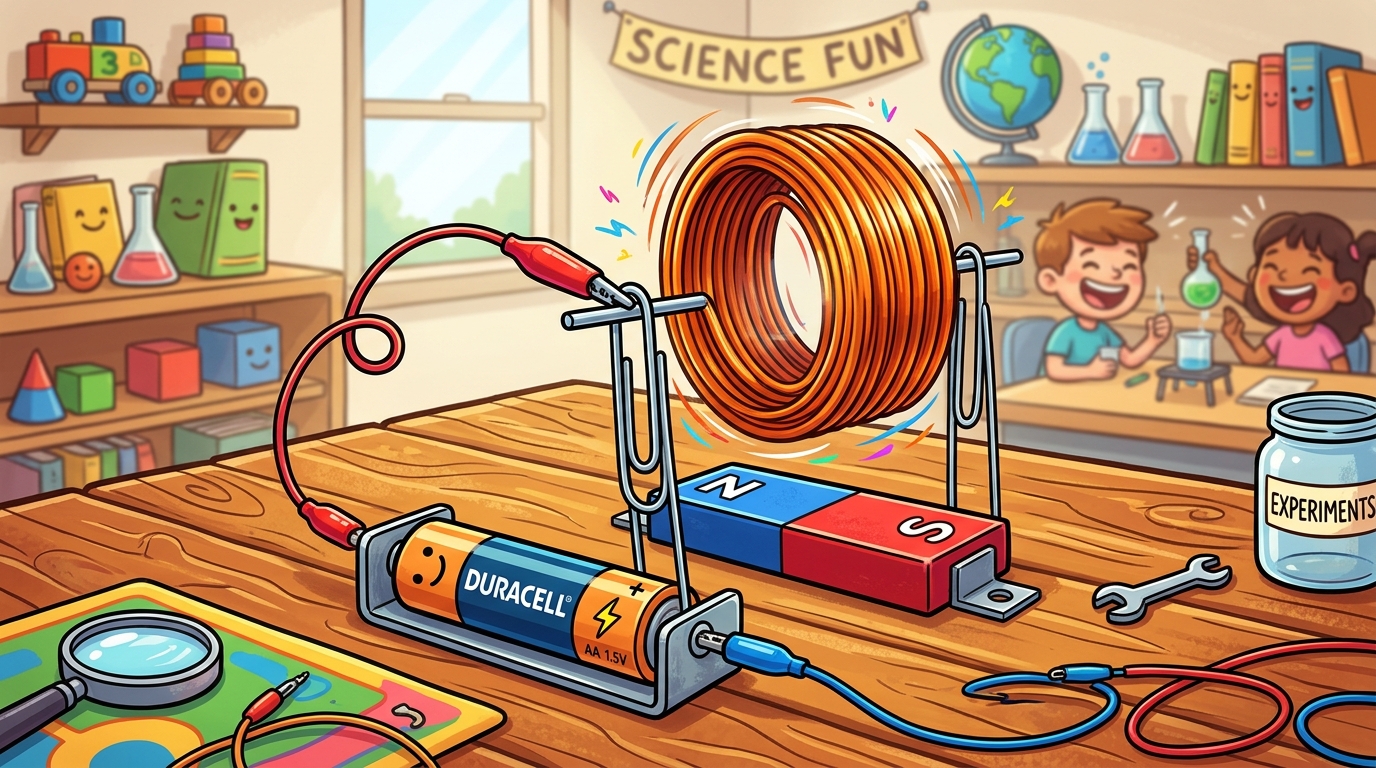
What if I told you that you can build a real working motor with just three things: a battery, a magnet, and some wire? 🔋
Electric motors are EVERYWHERE — in fans, washing machines, electric cars, toy robots, and even your phone (that's what makes it vibrate!). And the basic idea behind all of them is surprisingly simple.
It's all about electricity and magnetism working together! Let's build one!
How Does an Electric Motor Work?
An electric motor uses two scientific discoveries that changed the world:
- Electricity creates magnetism — When electricity flows through a wire, it creates a magnetic field around the wire
- Magnets push and pull each other — Opposite poles attract, same poles repel
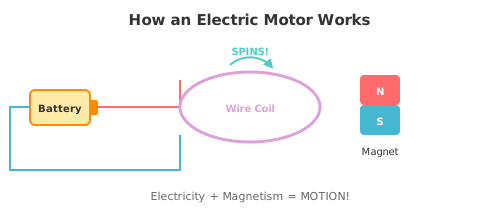
Put them together: when you run electricity through a coil of wire near a magnet, the coil spins! The magnetic field from the electricity interacts with the field from the magnet, creating a pushing and pulling force that makes the coil rotate.
Fun Fact! The world's most powerful electric motor (used in particle accelerators) can produce forces equivalent to the thrust of a small rocket!
Let's Build One! 🧪
This is a homopolar motor — the simplest type of electric motor you can make.
What You Need:
- 1 AA battery
- 1 small neodymium magnet (disc-shaped, about the size of a coin — find at hardware stores)
- About 12 inches of copper wire (bare copper works best, or strip the coating off)
- Needle-nose pliers (for bending)
Steps:
Step 1: Attach the magnet Stick the neodymium magnet to the flat (negative) end of the AA battery. The magnet should hang on and the battery should stand upright on the magnet.
Step 2: Shape the wire Bend the copper wire into a shape that:
- Touches the top (positive) terminal of the battery at the top
- Hangs down on both sides
- Barely touches the edge of the magnet at the bottom
A heart shape or a simple rectangular frame works great!
Step 3: Balance and watch! Carefully balance the wire on top of the battery so it makes contact at the top. If the bottom of the wire lightly touches the magnet... it should start SPINNING! 🌀
Why It Spins:
- Electricity flows from the battery → through the wire → through the magnet → back to the battery
- The current in the wire creates a magnetic field
- This field interacts with the magnet's field
- The force makes the wire spin!
Troubleshooting:
- Wire doesn't spin? Make sure the wire touches both the battery top AND the magnet
- Spins then stops? Adjust the wire shape so it keeps light contact
- Battery gets hot? The wire is touching too firmly. Make the contact lighter
How Real Motors Are More Complex
Your homopolar motor is cool, but real electric motors add some clever upgrades:
- Multiple coils arranged at different angles for smoother rotation
- A commutator that switches the current direction so the coil keeps spinning (without it, the coil would just flip once and stop!)
- Stronger electromagnets instead of permanent magnets
- Bearings for smooth, fast spinning
Electric Motors Are EVERYWHERE!
You probably use dozens of electric motors every single day:
- In your home: Fan, refrigerator, washing machine, blender, vacuum, garage door opener
- In electronics: Hard drives, DVD players, phone vibration motor
- In transportation: Electric cars, trains, e-bikes, scooters
- Fun stuff: Drones, RC cars, electric guitars (vibrato), roller coasters!
Fun Fact! A Tesla Model S has a single electric motor that produces 670 horsepower. That's the equivalent of 670 actual horses!
The History of Electric Motors
- 1821 — Michael Faraday built the first electric motor (a wire spinning around a magnet — very similar to what you just built!)
- 1834 — Thomas Davenport built the first practical DC motor
- 1888 — Nikola Tesla invented the AC induction motor (the type used in most home appliances today)
- Today — Electric motors convert about 95% of electrical energy into motion (gasoline engines only convert about 25%!)
Quick Quiz! ✅
Test what you learned:
- What two forces combine to make an electric motor spin?
- What happens when electricity flows through a wire?
- Name three things in your home that use electric motors.
(Answers: 1. Electricity and magnetism 2. It creates a magnetic field around the wire 3. Any three of: fan, fridge, washing machine, blender, vacuum, etc.)
Keep exploring, Science Buddy! There's always more to discover. 🔬