Grow Crystals at Home
With just hot water, sugar or salt, and a little patience, you can grow your own sparkling crystals! Learn about supersaturation and crystal structures.
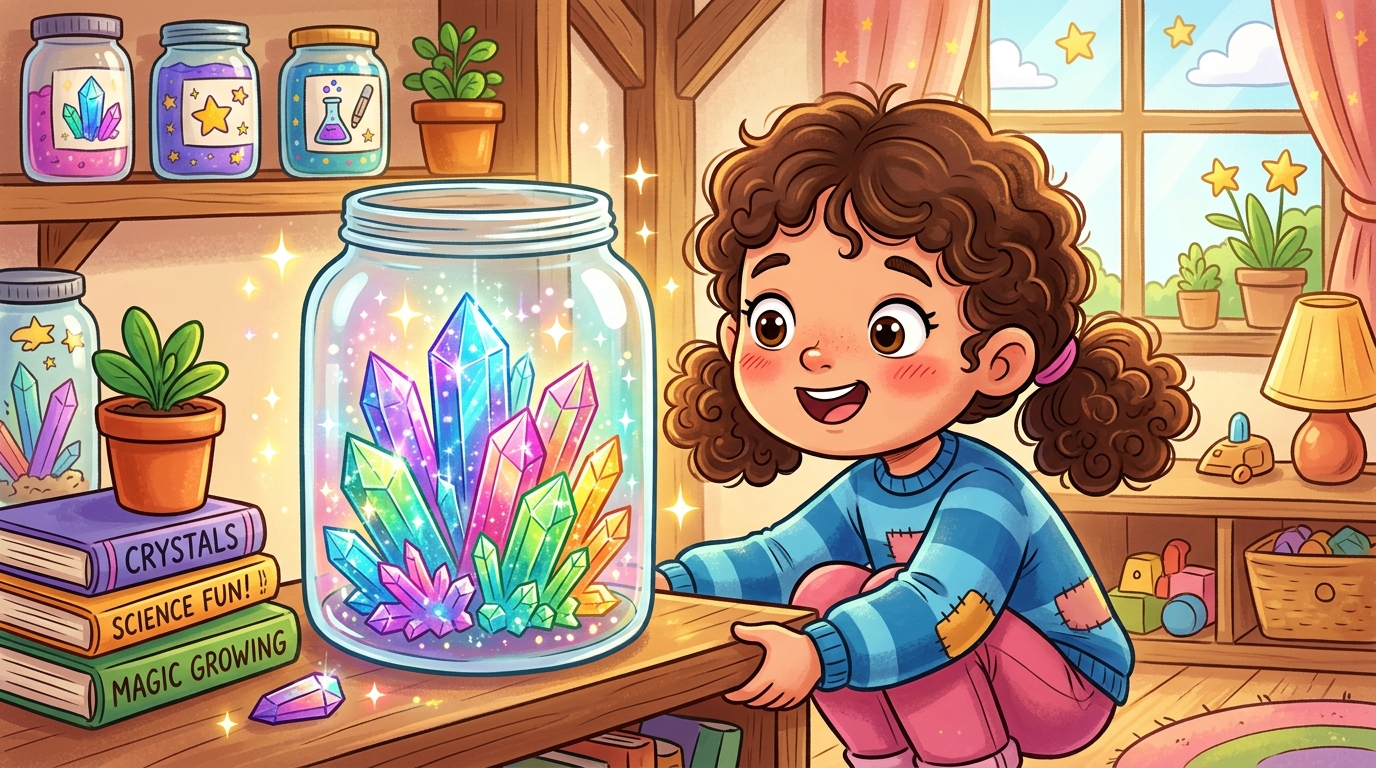
Diamonds, snowflakes, table salt, and even rock candy all have one thing in common: they're all crystals! 💎
A crystal is what happens when atoms or molecules arrange themselves in a perfect, repeating pattern — over and over, like the world's tiniest tile floor. And the coolest part? You can grow your own crystals at home!
Let's learn how crystals work and then make some!
What Makes Something a Crystal?
A crystal is any solid where the atoms or molecules are arranged in a regular, repeating 3D pattern (scientists call this a crystal lattice).
This perfect arrangement is what gives crystals their amazing properties:
- Flat, smooth faces (those shiny surfaces!)
- Geometric shapes (cubes, hexagons, needles)
- They can split cleanly along certain planes
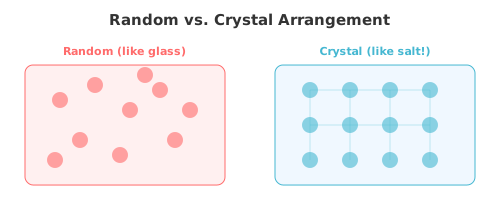
Not crystals? Things like glass, plastic, and chocolate have atoms arranged randomly — no pattern. Scientists call these amorphous (say it: uh-MORE-fuss) solids.
Fun Fact! Snowflakes are ice crystals, and no two are exactly alike! But they ALL have six sides because of how water molecules bond together.
The Magic Word: Supersaturation
To grow crystals, you need to understand one key concept: supersaturation.
Here's how it works:
- Hot water can dissolve MORE sugar (or salt) than cold water
- If you dissolve as much as possible in hot water, then let it cool...
- The water now has MORE dissolved stuff than it can hold!
- This is called a supersaturated solution
- The extra molecules have to come OUT of the water — and they do so by forming crystals!
It's like filling a room to max capacity, then shrinking the room. People have to leave — and they do so in an orderly line (the crystal structure)!
Grow Sugar Crystals (Rock Candy)! 🧪
This is the classic crystal-growing experiment — and you get to EAT the results! 🍭
What You Need:
- 3 cups of sugar
- 1 cup of water
- A pot and stove (with adult help!)
- A glass jar
- A wooden skewer or popsicle stick
- A clothespin
- Food coloring (optional, for colored crystals!)
- Patience (5-7 days!)
Steps:
Day 1: Make the solution
- Have an adult bring 1 cup of water to a boil
- Slowly stir in the sugar, about 1/4 cup at a time
- Keep stirring until ALL the sugar dissolves (the water should be clear, not cloudy)
- If you want colored crystals, add a few drops of food coloring
- Let it cool for about 15 minutes
Day 1: Set up the growing station
- Wet the wooden skewer and roll it in sugar (this gives the crystals a surface to start growing on — like cloud nuclei!)
- Let it dry completely (at least 30 minutes)
- Pour the sugar solution into the glass jar
- Lower the skewer into the jar, using a clothespin across the top to hold it in place
- Make sure the skewer doesn't touch the bottom or sides!
- Cover loosely with a paper towel
Days 2-7: Watch and wait!
- Check on your crystals each day. You should see small crystals forming within 24 hours!
- They'll get bigger and bigger each day
- DON'T move or bump the jar — crystals need stillness to grow
- After 5-7 days, pull out your rock candy and enjoy!
Fun Fact! The largest crystal ever found was a selenite crystal in Mexico's Naica Mine — it was 39 feet long and weighed 55 tons! It took about 500,000 years to grow.
Quick Crystal: Salt Crystals (2-3 Days)
Want faster results? Try salt!
What You Need:
- 1/2 cup of very hot water
- 1/4 cup of table salt
- A shallow dish or plate
- A magnifying glass
Steps:
- Dissolve the salt in hot water (stir well!)
- Pour a thin layer into the shallow dish
- Place it somewhere sunny and warm
- As the water evaporates over 2-3 days, salt crystals will form!
- Look at them with a magnifying glass — you'll see perfect little cubes!
Salt always forms cubes because sodium and chloride atoms arrange in a cubic lattice. It's geometry in nature!
Crystals in Your Daily Life
You're surrounded by crystals:
- Salt — Cubic crystals (NaCl)
- Sugar — Monoclinic crystals (that's why sugar grains look like tiny slanted boxes)
- Diamonds — Carbon atoms in a tetrahedral crystal structure
- Quartz — Found in watches, computers, and smartphones (it vibrates at an exact frequency when electricity passes through it!)
- Snowflakes — Hexagonal ice crystals
- Metals — Most metals are actually made of tiny crystals called "grains"
The Seven Crystal Systems
All crystals fall into one of seven basic shapes:
- Cubic — Like a box (salt, diamonds)
- Tetragonal — A stretched box
- Orthorhombic — Three different-length sides
- Hexagonal — Six-sided (snowflakes, quartz)
- Trigonal — Three-fold symmetry (calcite)
- Monoclinic — A tilted box (sugar)
- Triclinic — The least symmetrical
Quick Quiz! ✅
Test what you learned:
- What is a crystal?
- What does "supersaturation" mean?
- Why do salt crystals always form cubes?
(Answers: 1. A solid with atoms arranged in a regular, repeating 3D pattern 2. A solution that contains more dissolved substance than it can normally hold at that temperature 3. Because sodium and chloride atoms naturally arrange themselves in a cubic lattice structure)
Keep exploring, Science Buddy! There's always more to discover. 🔬