How Do Magnets Work?
What invisible force lets a magnet stick to your fridge or repel another magnet? It all comes down to electrons spinning inside atoms — like billions of tiny magnets working together!
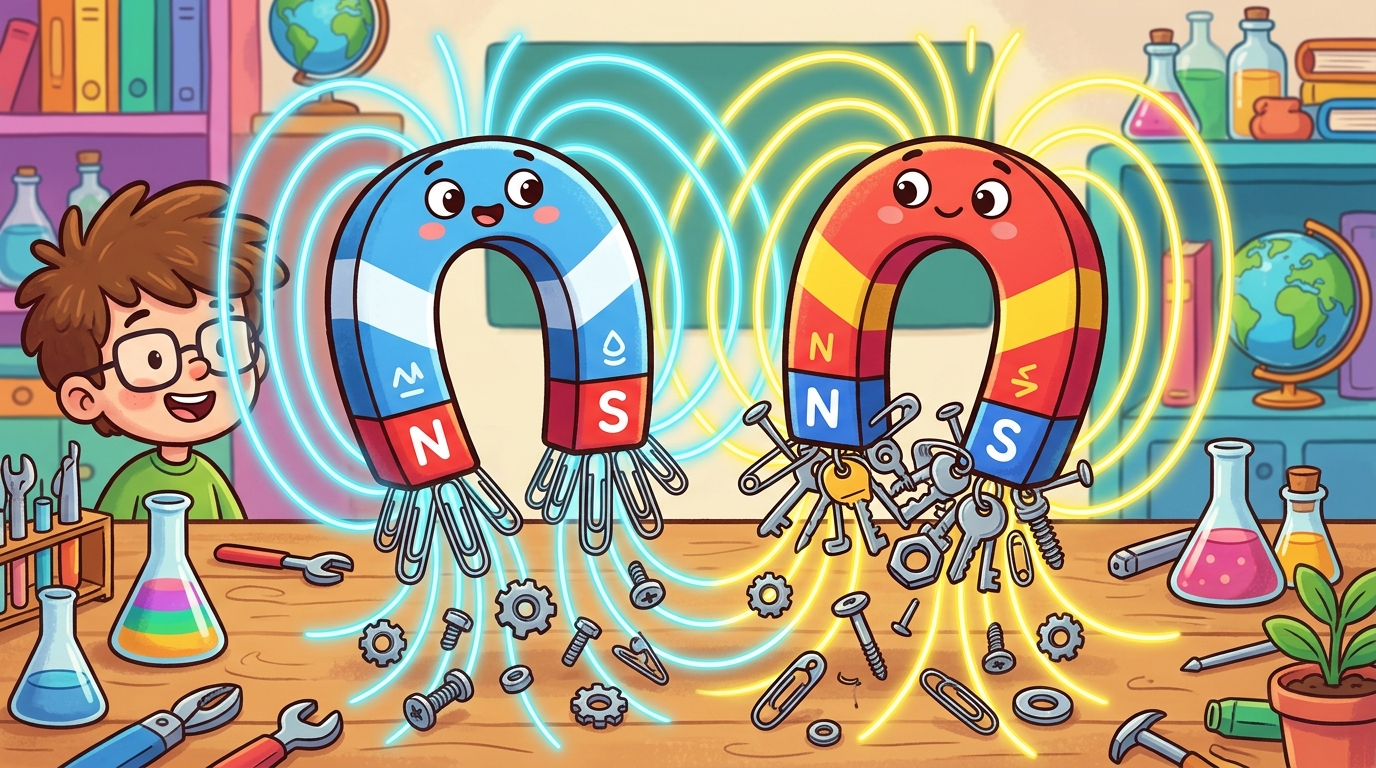
Stick a magnet on the fridge. It just... stays there. No glue. No tape. No string. Something invisible is holding it up! 🧲
Now try pushing two magnets together the wrong way. They push apart like there's an invisible force field between them!
What IS this magical force? How can it reach through air, paper, and even your hand? Let's find out!
Magnets Have Two Poles
Every magnet has two ends:
- North pole (usually marked N or colored red)
- South pole (usually marked S or colored blue)
And they follow one simple rule:
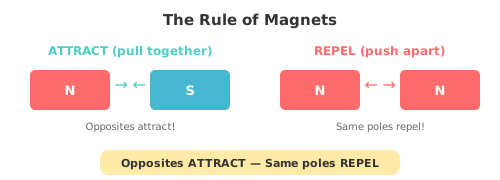
Fun Fact! If you break a magnet in half, you DON'T get a separate north and south pole. Each piece becomes a complete magnet with BOTH poles! You can break it into a million pieces and each one will have a north and south pole.
The Secret: It's All About Electrons!
To understand magnets, we need to go TINY — down to the atoms that make up everything.
Every atom has electrons zipping around it. And every electron does two things:
- It orbits the atom (goes around it)
- It spins on its axis (like a tiny spinning top)
Here's the key: a spinning electron creates a tiny magnetic field. Every single electron is like a microscopic magnet!
In most materials, the electrons spin in random directions, so their tiny magnetic fields cancel each other out. The material isn't magnetic.
But in materials like iron, nickel, and cobalt, something special happens...
Magnetic Domains: Tiny Magnet Teams
Inside iron, groups of atoms line up their electron spins in the same direction. Each group is called a magnetic domain — think of it like a tiny team of atoms all pointing their magnetism the same way.
A regular piece of iron has millions of domains, but they point in random directions:
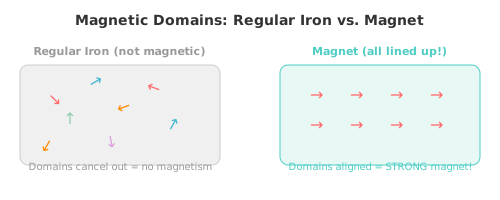
When you magnetize iron (by rubbing it with a magnet or using electricity), the domains all line up in the same direction. Now all those tiny magnetic forces ADD UP instead of canceling out, and you get a strong magnet!
Earth Is a Giant Magnet!
Here's something amazing: the entire Earth is a magnet! 🌍
Deep inside Earth, liquid iron and nickel flow and swirl in the outer core. This moving metal creates a massive magnetic field that extends thousands of miles into space!
This magnetic field is why compass needles point north — they're lining up with Earth's magnetic field.
It also protects us from dangerous particles that the Sun shoots at us (called the solar wind). Without Earth's magnetic field, life on our planet might not exist!
Fun Fact! Earth's magnetic poles actually FLIP every few hundred thousand years! North becomes South and South becomes North. The last flip was about 780,000 years ago. We're overdue for the next one!
What Can You Do With Magnets?
Magnets are everywhere in your daily life:
- Fridge magnets (obviously! 😄)
- Speakers and headphones — magnets move a cone to create sound waves
- Electric motors — magnets spinning creates motion (in your fan, car, blender)
- MRI machines — SUPER powerful magnets help doctors see inside your body
- Credit card strips — tiny magnetic particles store your data
- Maglev trains — magnets lift the entire train off the tracks for frictionless super-speed travel!
Try It Yourself! 🧪
Make a Magnet!
What you need:
- A strong magnet (a refrigerator magnet works)
- A large iron nail or paper clip
- Small paper clips to test with
Steps:
- Take the nail and try to pick up small paper clips. It shouldn't attract them (it's not magnetized yet)
- Take your strong magnet and rub it along the nail, always in the same direction — about 50 times
- Now try the nail on the paper clips again — it should pick them up!
- You just aligned the magnetic domains inside the nail! 🎉
Bonus: To demagnetize it, drop the nail on a hard surface several times. The impact jumbles the domains back to random!
Quick Quiz! ✅
Test what you learned:
- What happens when you put two north poles together?
- What creates magnetism at the atomic level?
- What is a magnetic domain?
(Answers: 1. They repel (push apart) 2. Spinning electrons create tiny magnetic fields 3. A group of atoms with their electron spins aligned in the same direction)
Keep exploring, Science Buddy! There's always more to discover. 🔬