How Do Volcanoes Form?
Earth's surface is cracked into giant puzzle pieces that move around. When they collide or pull apart, hot melted rock erupts — and that's a volcano!
KABOOM! 🌋
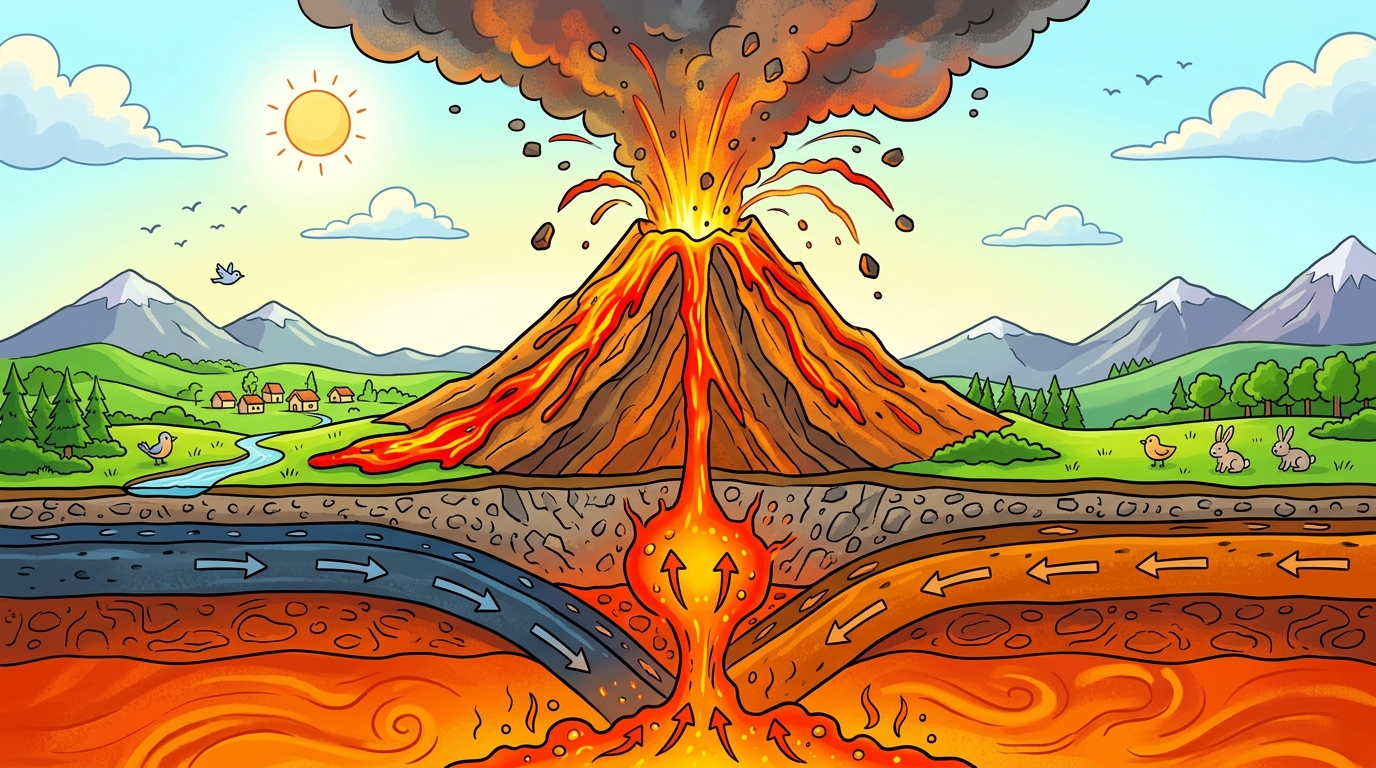
A mountain just EXPLODED! Red-hot melted rock shoots into the sky, rivers of lava flow down the sides, and a massive cloud of ash darkens the sky!
That's a volcanic eruption — one of the most powerful and dramatic things that happens on our planet. But what causes it? And why do volcanoes only form in certain places?
Let's dive deep — all the way to the center of the Earth!
Earth Is Like a Hard-Boiled Egg
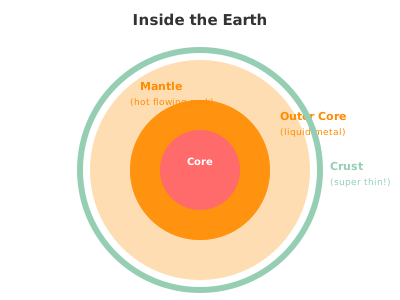
Imagine cutting a hard-boiled egg in half. You'd see:
- The shell → That's Earth's crust (the ground you walk on!)
- The egg white → That's Earth's mantle (thick, super-hot rock that can flow slowly)
- The yolk → That's Earth's core (insanely hot — about 10,000°F!)
The crust is actually VERY thin compared to the rest of Earth. If Earth were an apple, the crust would be thinner than the apple's skin!
Fun Fact! The deepest hole humans have ever drilled is about 7.5 miles deep. But Earth's crust alone is up to 25 miles thick under continents — we haven't even gotten through the shell!
The Giant Puzzle: Tectonic Plates
Here's the really cool part: Earth's crust isn't one solid piece. It's cracked into about 15 huge pieces called tectonic plates that float on top of the hot, gooey mantle.
These plates are ALWAYS moving — very slowly, about as fast as your fingernails grow (1-2 inches per year). But over millions of years, they've moved entire continents!
And where these plates meet? That's where the action happens! 🔥
Three Ways Volcanoes Form
1. Plates Smashing Together (Subduction)
When two plates collide, one plate slides UNDER the other and gets pushed deep into the Earth. Down there, it's so hot that rock melts into magma (underground lava). The magma is lighter than the rock around it, so it rises up and — ERUPTION!
This is how the volcanoes in the "Ring of Fire" around the Pacific Ocean formed!
2. Plates Pulling Apart (Divergent Boundaries)
When two plates pull away from each other, magma from below rises up to fill the gap. This creates long chains of underwater volcanoes!
Most of this happens at the bottom of the ocean. In fact, the longest mountain chain on Earth is the Mid-Atlantic Ridge — an underwater volcanic mountain range that runs down the middle of the Atlantic Ocean!
3. Hot Spots (Middle of a Plate)
Sometimes there's an extra-hot area deep in the mantle called a hot spot. This sends a plume of magma burning up through the plate above — even if it's nowhere near a plate boundary!
Hawaii was formed this way! The Pacific Plate slowly moves over a hot spot, and new islands keep forming one after another.
Fun Fact! Right now, a new Hawaiian island called Lo'ihi is forming underwater, about 3,000 feet below the surface. It should break the surface in about 10,000-100,000 years!
Lava vs. Magma — What's the Difference?
This is an easy one:
- Magma = melted rock that's still UNDERGROUND
- Lava = melted rock that has come OUT of the volcano
Same stuff, different location! It's like how water is called "rain" when it's falling from the sky but "a puddle" when it's on the ground.
Types of Volcanoes
Not all volcanoes look the same!
- Shield Volcanoes — Wide and flat, like an upside-down shield. Lava flows gently. (Example: Mauna Loa in Hawaii)
- Stratovolcanoes — Tall and steep with violent eruptions. The classic volcano shape! (Example: Mount Fuji in Japan)
- Cinder Cone Volcanoes — Small and steep, built from chunks of lava that pile up. (Example: Parícutin in Mexico)
Try It Yourself! 🧪
Build a Mini Volcano
What you need:
- A small plastic bottle
- Clay or playdough (to build the mountain shape around it)
- Baking soda (2 tablespoons)
- Vinegar (about 1/2 cup)
- Red food coloring
- Dish soap (a squirt)
- A tray to catch the mess!
Steps:
- Place the bottle on the tray and build a mountain shape around it with clay
- Put baking soda inside the bottle
- Add a squirt of dish soap and a few drops of red food coloring
- When you're ready for the eruption, pour in the vinegar and step back!
- Watch your volcano "erupt!" The baking soda + vinegar creates carbon dioxide gas (just like real volcanoes release gas that pushes magma up!)
Quick Quiz! ✅
Test what you learned:
- What are the giant pieces of Earth's crust called?
- What's the difference between magma and lava?
- How were the Hawaiian islands formed?
(Answers: 1. Tectonic plates 2. Magma is underground, lava is above ground 3. The Pacific Plate moved over a hot spot, forming one island after another)
Keep exploring, Science Buddy! There's always more to discover. 🔬