How Does Soap Actually Clean Things?
Soap molecules are like tiny superheroes with a split personality — one end loves water and the other loves oil. Together, they capture dirt and wash it away!
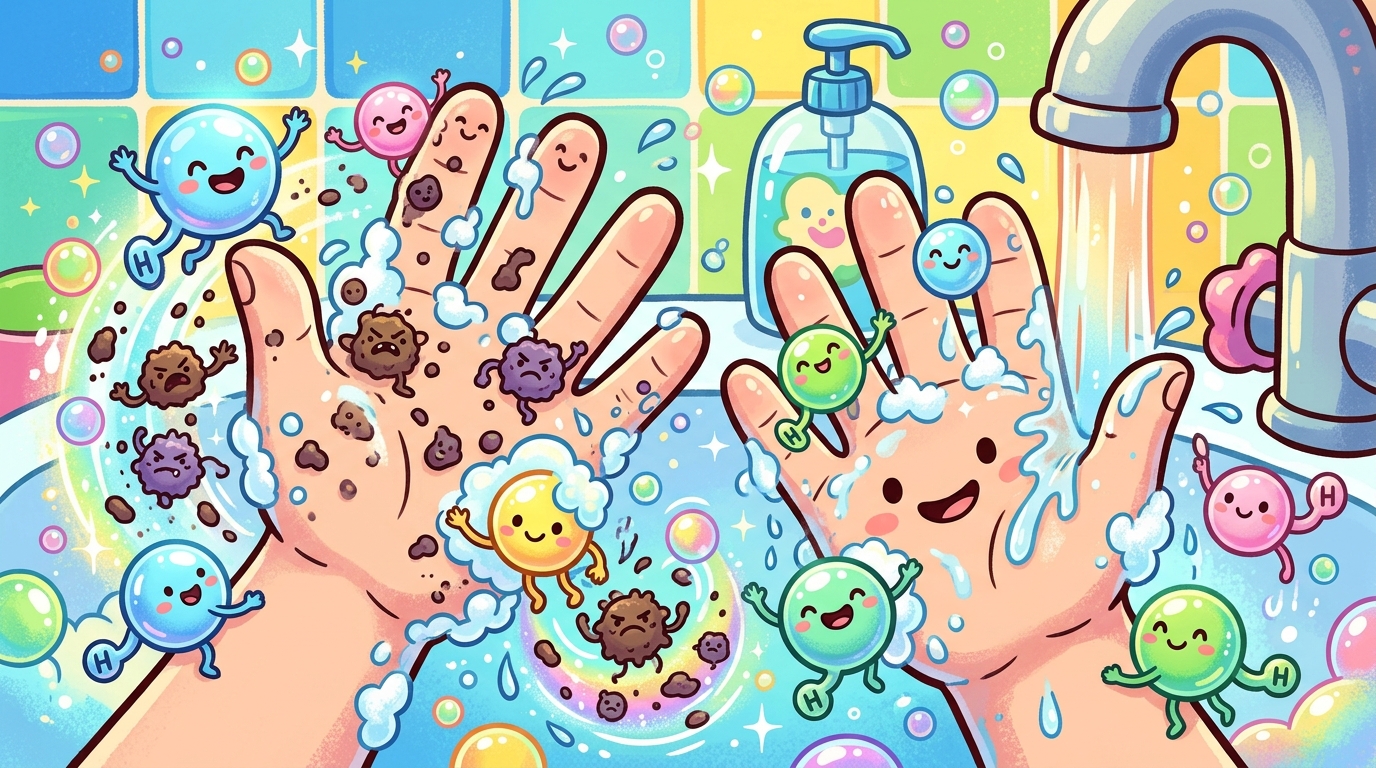
Your hands are covered in invisible germs and grease. You turn on the water and add soap. You scrub for 20 seconds and rinse. Clean! ✨
But have you ever wondered... what is soap actually DOING? How does it grab onto invisible dirt and germs and wash them away?
The answer involves some seriously cool chemistry and molecules that are basically tiny superheroes with a split personality!
Water Alone Isn't Enough
Here's the problem: most dirt, oil, and germs are greasy. And grease and water do NOT mix.
Try it: put a drop of oil in water. It just floats on top, right? Water molecules are attracted to other water molecules, so they stick together and push the oil away. Scientists call this surface tension.
That's why just rinsing your hands with water doesn't get them truly clean. The water slides right over the greasy germs!
Fun Fact! A small water droplet has about 1.5 sextillion water molecules in it. That's 1,500,000,000,000,000,000,000! And they all hold hands with each other!
Meet the Soap Molecule: A Two-Headed Hero!
Each soap molecule has two very different ends:
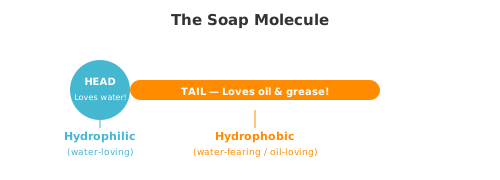
- The head (round end) is hydrophilic — it LOVES water and is attracted to it
- The tail (long end) is hydrophobic — it HATES water but LOVES oil and grease
This split personality is what makes soap so amazing!
The Cleaning Action: Three Steps
Step 1: The tails grab the grease
When you add soap to your dirty hands, the oil-loving tails dive straight into the grease and dirt. They're like "Finally! My favorite thing!"
Step 2: They form a bubble around it
Lots of soap molecules surround each blob of grease, with their tails pointing inward (into the grease) and their heads pointing outward (into the water). This creates a tiny ball called a micelle (say it: my-SELL).
Step 3: Water washes the micelles away
Since the outside of each micelle is covered in water-loving heads, the water can now grab onto it and carry it away when you rinse!
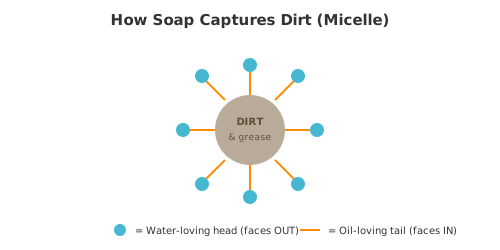
It's like wrapping a greasy stain in a tiny water-friendly blanket so water can carry it away!
Soap vs. Germs: The Virus Destroyer! 🦠
Soap doesn't just clean dirt — it's also deadly to many germs, especially viruses!
Many viruses (including the ones that cause colds and flu) are wrapped in a fatty outer layer called a lipid envelope. It's basically a coat of grease that protects the virus.
Guess what soap's oil-loving tails LOVE to grab onto? That's right — grease!
The soap molecules rip apart the virus's greasy coat, destroying it completely. That's why washing your hands with soap is one of the BEST ways to avoid getting sick!
Fun Fact! Washing your hands with soap for just 20 seconds (sing "Happy Birthday" twice!) can reduce germs on your hands by up to 99%!
Bar Soap vs. Liquid Soap
Both work the same way! The main difference:
- Bar soap is made with sodium hydroxide (a.k.a. lye)
- Liquid soap is made with potassium hydroxide
Both create those awesome two-headed molecules. So use whichever you prefer — just make sure to scrub for 20 seconds!
The History of Soap
Humans have been making soap for nearly 5,000 years!
- Ancient Babylonians (around 2800 BC) made soap from animal fat and wood ash
- Ancient Romans discovered that mixing fat with the ash from Mt. Vesuvius made great cleaning soap
- Medieval Europe had soap-making as a major industry
- Today's soap is made from plant oils (like coconut or olive oil) mixed with chemicals
Try It Yourself! 🧪
Soap vs. Surface Tension Experiment
What you need:
- A bowl of water
- Black pepper
- Dish soap
- Your finger!
Steps:
- Fill a bowl with water
- Shake a good amount of black pepper across the surface (it floats because of surface tension!)
- Dip your clean finger in — the pepper barely moves
- Now put a tiny drop of dish soap on your fingertip
- Touch the water and — WHOOSH! — the pepper shoots to the edges! 🤯
Why? The soap breaks the water's surface tension. The water molecules at the edges still have strong surface tension, so they pull the pepper toward them!
Quick Quiz! ✅
Test what you learned:
- What are the two parts of a soap molecule called?
- What is a micelle?
- How does soap destroy viruses?
(Answers: 1. The hydrophilic (water-loving) head and hydrophobic (oil-loving) tail 2. A tiny ball of soap molecules surrounding a blob of grease, with tails pointing in and heads pointing out 3. It rips apart the virus's fatty outer coating)
Keep exploring, Science Buddy! There's always more to discover. 🔬