Human Body Systems for Kids: Free Activities, Experiments & Lesson Plans
Explore 6 body systems with free interactive activities, hands-on experiments, and printable worksheets for grades 4-5. Includes a free digital lesson preview.
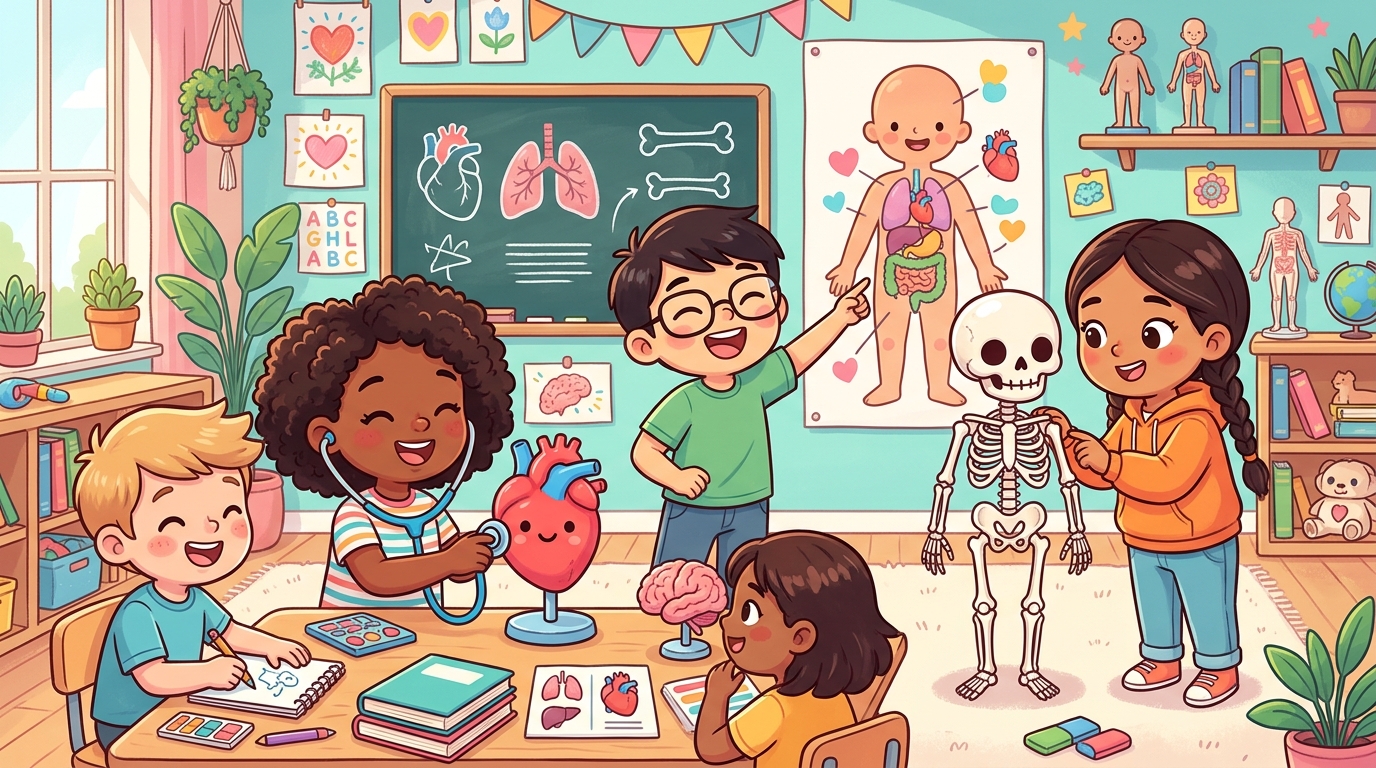
Your body is an incredible machine. Right now, as you read this, your heart is pumping blood, your lungs are breathing air, your stomach is digesting food, and your brain is processing every single word — all at the same time. Teaching kids how these body systems work together is one of the most exciting topics in elementary science.
In this article, you'll find free interactive activities, hands-on experiments, and a printable worksheet to help your students explore the human body. Plus, we'll show you inside our complete 6-day digital lesson that covers all six major body systems with slides, drag-and-drop activities, vocabulary flashcards, and more.
Whether you're teaching 4th or 5th graders, this resource has everything you need for an engaging body systems unit.
The 6 Body Systems Every Student Should Know
Before diving into the activities, here's a quick overview of the six systems covered in this lesson:
The Skeletal System
Your skeleton is made up of 206 bones that give your body shape, protect your organs, and help you move. Your skull protects your brain, your ribcage guards your heart and lungs, and your spine keeps you standing tall. Inside your bones, bone marrow makes millions of new blood cells every day. Bones meet at joints — places like your knees and elbows where movement happens. There are three types: hinge joints (like a door), ball-and-socket joints (like your shoulder), and pivot joints (like your neck turning).
The Muscular System
Your body has over 600 muscles, and they come in three types. Skeletal muscles are the ones you control — they help you run, jump, and wave. Smooth muscles work automatically inside your body, pushing food through your digestive system. And cardiac muscle is the special muscle that makes up your heart — it never stops beating your entire life! Muscles can only pull, not push, so they work in pairs. When your biceps contracts, your arm bends. When your triceps contracts, your arm straightens. Muscles connect to bones through tough cords called tendons.
The Circulatory System
Your circulatory system is like a highway for blood. Your heart has 4 chambers and pumps blood through arteries (away from the heart), capillaries (tiny vessels where oxygen is delivered), and veins (back to the heart). Your blood carries red blood cells with oxygen, white blood cells that fight germs, and platelets that heal cuts.
The Respiratory System
Every breath you take follows a path: air enters through your nose or mouth, travels down the trachea (windpipe), splits into bronchi (one for each lung), and fills millions of tiny air sacs called alveoli. This is where the magic happens — oxygen passes into your blood while carbon dioxide passes out. Your diaphragm, a dome-shaped muscle under your lungs, powers the whole process.
The Digestive System
Food's journey starts in your mouth, where teeth and saliva begin breaking it down. It slides down the esophagus through a squeezing motion called peristalsis, lands in your stomach where acid breaks it into mush, then moves through your small intestine (20 feet long!) where nutrients are absorbed into your blood. The large intestine absorbs water, and waste exits the body.
The Nervous System
Your brain is the command center of your entire body, with about 86 billion neurons (nerve cells) sending electrical signals at up to 268 miles per hour. The spinal cord connects your brain to the rest of your body, and nerves branch out everywhere. Your nervous system controls everything — from conscious actions like walking to reflexes like pulling your hand away from something hot.
Free Interactive Activity: Label the Body
Want your students to explore these body systems right now? Our free Day 1 preview includes an interactive drag-and-drop activity where students label major organs on a colorful body diagram.
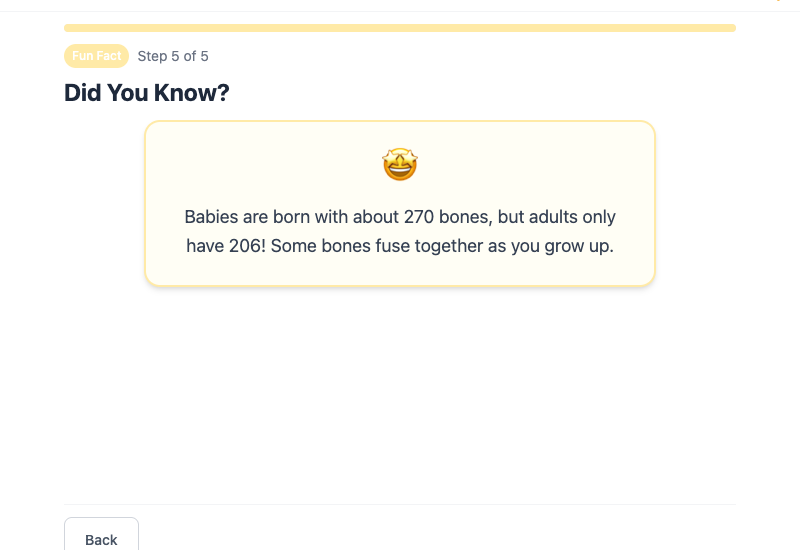
Students drag colored labels (Brain, Lungs, Heart, Stomach, Intestines) to their correct positions, with leader lines connecting each drop zone to the organ. When they place a label correctly, they get a fun fact about that organ!
Try the free Day 1 preview — includes the intro slide, skeletal system teaching slide, label-the-body activity, vocabulary flashcards, and a fun fact.
Free Printable: Label the Body Systems Worksheet
Print this worksheet for a hands-on companion to the digital activity. Students label the major organs on a body diagram using a word bank.
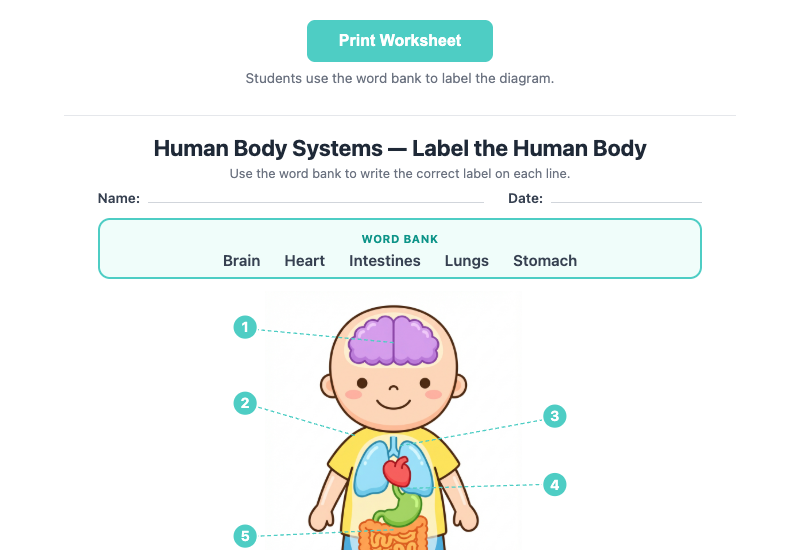
Print the free worksheet — perfect for independent practice, homework, or assessment.
Hands-On Experiments
These experiments bring body systems to life with everyday materials. We're sharing 2 of the 3 experiments from the full lesson — try them in your classroom!
Experiment 1: Heart Rate Investigation
What you'll learn: How the circulatory and muscular systems work together during exercise.
Materials:
- A timer or stopwatch
- A pencil and paper to record results
- Space to do jumping jacks
Steps:
- Sit quietly for 1 minute. Place two fingers on your wrist or neck to feel your pulse.
- Count how many beats you feel in 15 seconds. Multiply by 4 — that's your resting heart rate!
- Write down your resting heart rate.
- Now do jumping jacks for 1 full minute!
- Immediately count your pulse again for 15 seconds and multiply by 4.
- Write down your active heart rate. How much did it change?
- Rest for 2 minutes and measure again. How long does it take to return to normal?
Think about it:
- How much faster did your heart beat after exercising?
- Why do you think your heart beats faster when you exercise?
- How long did it take for your heart rate to go back to normal?
Fun fact: An athlete's heart is so strong that it beats fewer times per minute at rest than a non-athlete's heart!
Experiment 2: Reaction Time Ruler Drop
What you'll learn: How fast your nervous system can send signals from your eyes to your brain to your fingers.
Materials:
- A 30 cm ruler (or 12 inch ruler)
- A partner
- A pencil and paper to record results
Steps:
- Have your partner hold the ruler at the top, letting it hang straight down.
- Place your thumb and finger at the bottom of the ruler (at the 0 mark) — but don't touch it!
- Your partner drops the ruler without warning. Catch it as fast as you can!
- Check where your fingers caught the ruler. Write down the number.
- Try 5 times and find your average. The lower the number, the faster your reaction!
- Switch roles and test your partner.
- Try it with your other hand — is it faster or slower?
Think about it:
- Which hand had the faster reaction time?
- What parts of your nervous system were involved in catching the ruler?
- Do you think practice would make your reaction time faster? Why?
Fun fact: A nerve signal from your finger to your brain and back takes about 0.15 seconds — that's 150 milliseconds!
Want printable experiment cards and observation journals for all 3 experiments? They're included in the full lesson.
Inside the Full 6-Day Lesson
Our complete Human Body Systems digital lesson gives you everything you need to teach all six body systems over 6 days. Here's what it looks like:
Teacher Dashboard
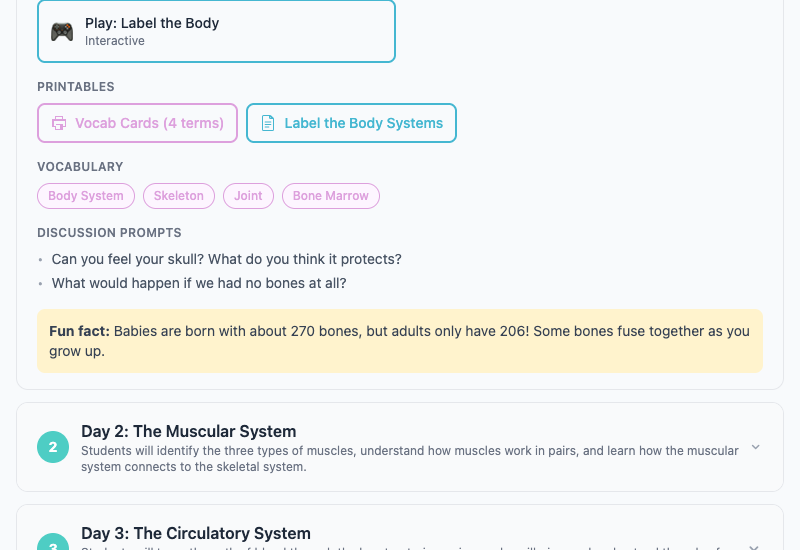
The teacher dashboard gives you a complete overview of each day — learning objectives, slides, activities, printables, vocabulary, and discussion prompts all in one place.
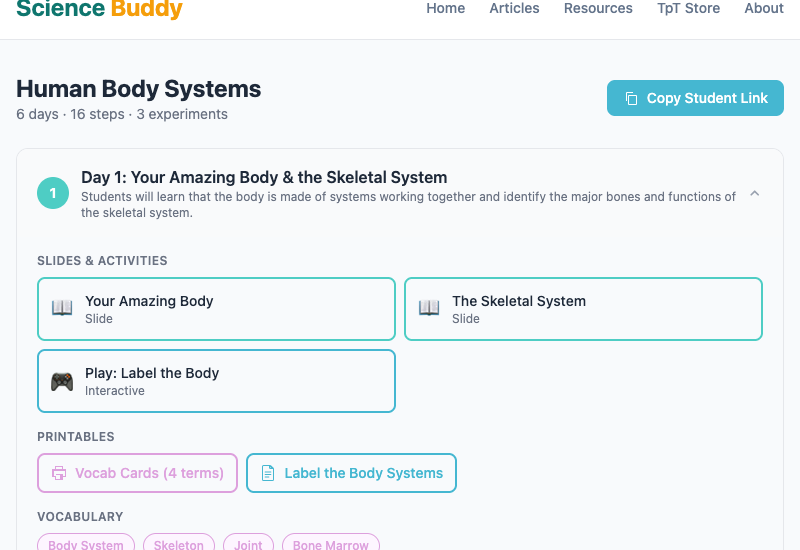
Scroll down to see printable resources, vocabulary tags, and discussion prompts for each day:
Student Experience
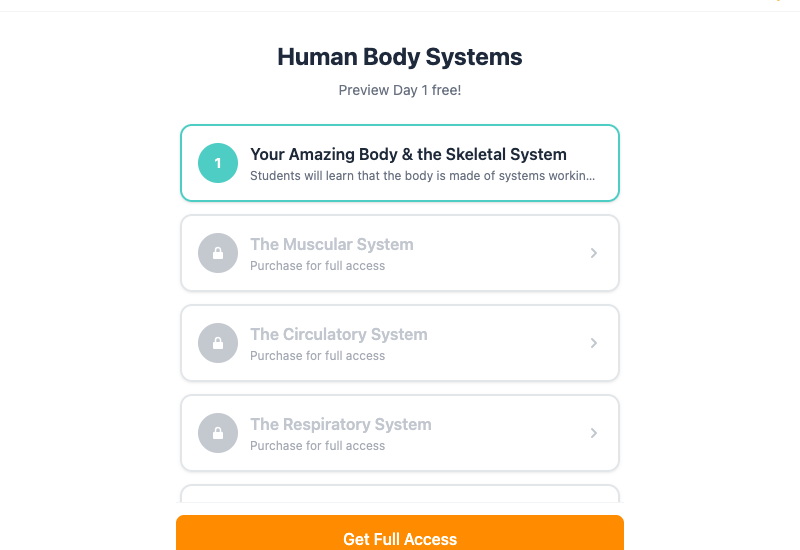
Students pick their day and work through slides, activities, and vocab cards at their own pace:
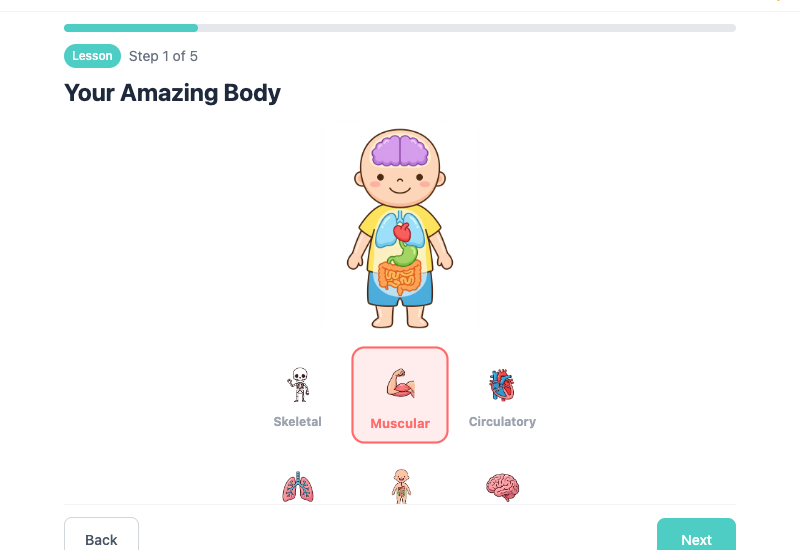
Each day starts with colorful teaching slides that introduce the body system with key facts and fun visuals:
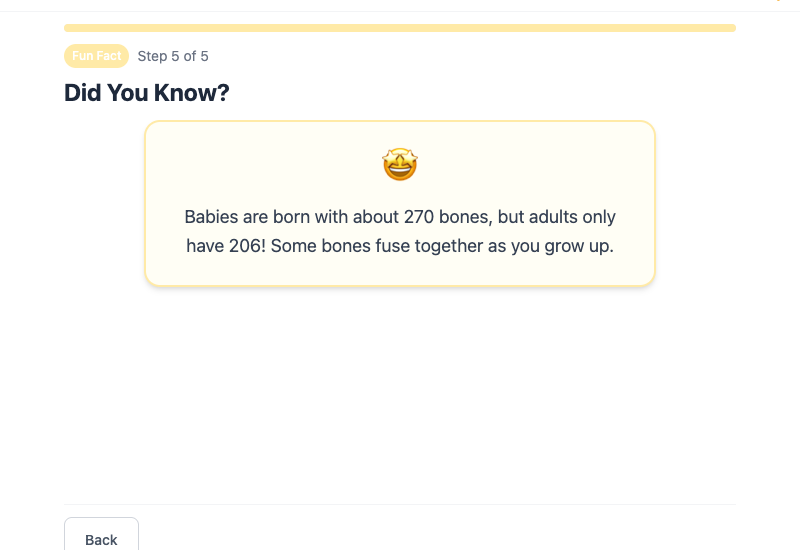
Vocabulary flashcards are built into each day — students tap to flip and learn key terms:
What's Included
- 6 daily lesson plans with learning objectives and discussion prompts
- 10 teaching slides with colorful diagrams and key facts
- 6 interactive activities (drag-and-drop labeling, sorting, quizzes, connection mapping)
- 3 hands-on experiments with printable experiment cards
- 24 vocabulary flashcards (4 per day, tap-to-flip)
- 3 printable worksheets (anatomy labeling, digestion sequencing, compare chart)
- Observation journals for experiment days
- Fun facts and "Did You Know?" moments throughout
The 6-Day Plan
| Day | Topic | Highlights |
|---|---|---|
| 1 | Your Amazing Body & Skeletal System | Body systems intro, label-the-body activity |
| 2 | The Muscular System | Muscle types, how muscles work in pairs |
| 3 | The Circulatory System | Blood flow path, blood flow quiz, heart rate experiment |
| 4 | The Respiratory System | Air pathway, breathing quiz, digestion experiment |
| 5 | The Digestive System | Food's journey, digestion ordering activity |
| 6 | Nervous System & Systems Together | System sorting, connection map, celebration |
Get the Full Lesson
Try Day 1 free — no account needed:
Ready for the complete 6-day lesson with all activities, experiments, worksheets, and teacher tools?
Get the full lesson on Teachers Pay Teachers
More Free Science Lessons
Looking for more interactive science content? Check out these free resources:
- Plant Life Cycle — 5-day guided lesson on seeds, growth, and pollination
- Butterfly Life Cycle — 5-day guided lesson on metamorphosis
- Forms of Energy — 5-day guided lesson on light, sound, heat, and motion
- Circuit Builder — Build and test virtual circuits