Make a Cloud in a Jar
Create your own real cloud using warm water, ice, and hairspray! Learn how real clouds form in the sky through condensation and tiny particles called nuclei.
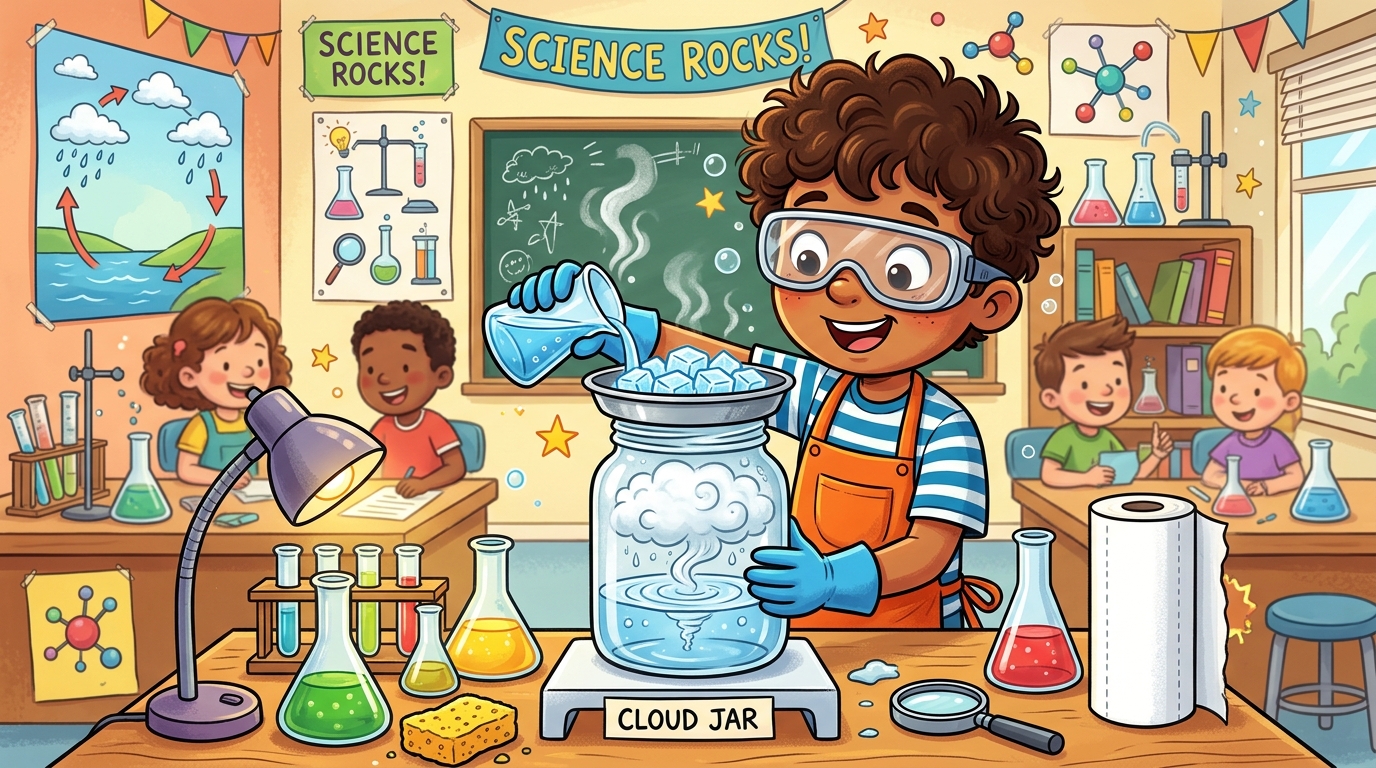
Look up at the sky on a nice day. Those fluffy white clouds look like cotton candy floating in the air! ☁️
But what ARE clouds, actually? They're not smoke. They're not steam. And they're definitely not solid (you can't stand on one, even though they look like you should be able to!).
Clouds are actually made of billions of tiny water droplets — so tiny that they float in the air! And today, you're going to make your own cloud. IN A JAR!
What Is a Cloud, Really?
A cloud is a big collection of super-tiny water droplets (or ice crystals if it's cold enough) floating in the atmosphere.
Each droplet is about 10 micrometers across — that's 100 times thinner than a human hair! They're so small and light that air currents keep them floating.
A typical cumulus cloud (the fluffy white kind) contains about 500 million grams of water — that's over 1 million pounds! But because it's spread across billions of tiny droplets over a huge area, it floats!
Fun Fact! An average cumulus cloud weighs about the same as 100 elephants! 🐘 But it's spread across such a large volume that it floats in the air.
How Real Clouds Form
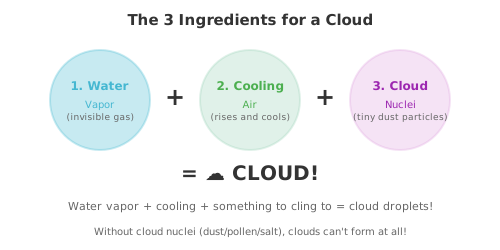
Clouds form through three ingredients working together:
Step 1: Water evaporates
The sun heats water in oceans, lakes, and rivers. The water evaporates — turning from liquid into an invisible gas called water vapor.
Step 2: Warm air rises and cools
Warm air containing water vapor rises up into the atmosphere. The higher it goes, the cooler it gets. (That's why mountaintops are cold!)
Step 3: Condensation needs a surface
When the air cools enough, the water vapor wants to turn back into liquid droplets. But it can't just condense out of thin air — it needs a tiny surface to cling to!
These surfaces are called cloud condensation nuclei — teeny tiny particles of:
- Dust
- Pollen
- Sea salt
- Even pollution or volcanic ash!
Each water droplet forms around one of these tiny specks. Billions of droplets together = a cloud!
Fun Fact! If the air were perfectly clean with zero dust particles, clouds couldn't form at all! We need a little bit of "dirty" air for clouds to exist.
Let's Make a Cloud! 🧪
What You Need:
- A large glass jar (like a mason jar) with a lid
- Hot water (not boiling — just from the tap on its hottest setting)
- Ice cubes
- Hairspray
- A dark background to see the cloud better
Steps:
Step 1: Add hot water Pour about 1 inch of hot water into the jar. Swirl it around to warm the glass. The hot water provides water vapor (Ingredient #1).
Step 2: Spray hairspray Quickly spray a little hairspray into the jar (just a quick spritz — 1 second). This provides cloud condensation nuclei — tiny particles for the water to cling to (Ingredient #3).
Step 3: Put ice on top Immediately place the lid upside down on top of the jar and put several ice cubes on the lid. The ice provides the cooling (Ingredient #2).
Step 4: Watch! Wait about 30 seconds and look into the jar against a dark background. You should see a swirling, misty cloud forming inside!
Step 5: Release the cloud Remove the lid and watch your cloud escape and float away!
Why It Works:
- Hot water evaporates → water vapor fills the jar
- Ice cools the air at the top → water vapor condenses
- Hairspray particles → give the vapor something to cling to
- Result: tiny water droplets form = a real cloud!
Types of Clouds
Not all clouds are created equal! Here are the main types:
- Cumulus — Fluffy, white, cotton-ball clouds (fair weather) ☁️
- Stratus — Flat, gray, blanket-like layers (overcast days)
- Cirrus — Thin, wispy, high-altitude ice crystal clouds
- Cumulonimbus — The big boss! Towering thunderstorm clouds that can reach 60,000 feet high! ⛈️
The name tells you about the cloud:
- "Cumulo" = heaped or piled
- "Strato" = layered or flat
- "Cirro" = high up, wispy
- "Nimbo/Nimbus" = rain-producing
Clouds on Other Planets!
Clouds aren't just an Earth thing:
- Venus — Has clouds made of sulfuric acid! ☠️
- Jupiter — Giant clouds of ammonia, with the Great Red Spot being a storm bigger than Earth!
- Saturn's moon Titan — Has clouds of liquid methane (natural gas!)
- Neptune — Has the fastest winds in the solar system (1,200 mph!) whipping its clouds around
Try This Too: Cloud in a Bottle
For a quicker version:
What you need:
- A clear plastic bottle with a cap
- A little warm water
- A match (with adult help!)
Steps:
- Put a small amount of warm water in the bottle
- Have an adult light a match and drop it into the bottle
- Quickly cap the bottle
- Squeeze the bottle hard, then release it quickly
- When you release, you should see a cloud form!
The match provides smoke particles (nuclei), and squeezing then releasing changes the air pressure, which causes cooling — just like in the real atmosphere!
Quick Quiz! ✅
Test what you learned:
- What are clouds made of?
- What three things do you need to make a cloud?
- What are cloud condensation nuclei?
(Answers: 1. Billions of tiny water droplets (or ice crystals) floating in air 2. Water vapor, cooling, and cloud condensation nuclei (tiny particles) 3. Tiny particles like dust, pollen, or sea salt that water vapor clings to when forming droplets)
Keep exploring, Science Buddy! There's always more to discover. 🔬