Properties of Matter for Kids: Free Activities, Experiments & Lesson Plans
Explore properties of matter with free interactive activities, hands-on experiments, and a printable worksheet. Preview our complete 7-day lesson plan for 4th-5th grade.
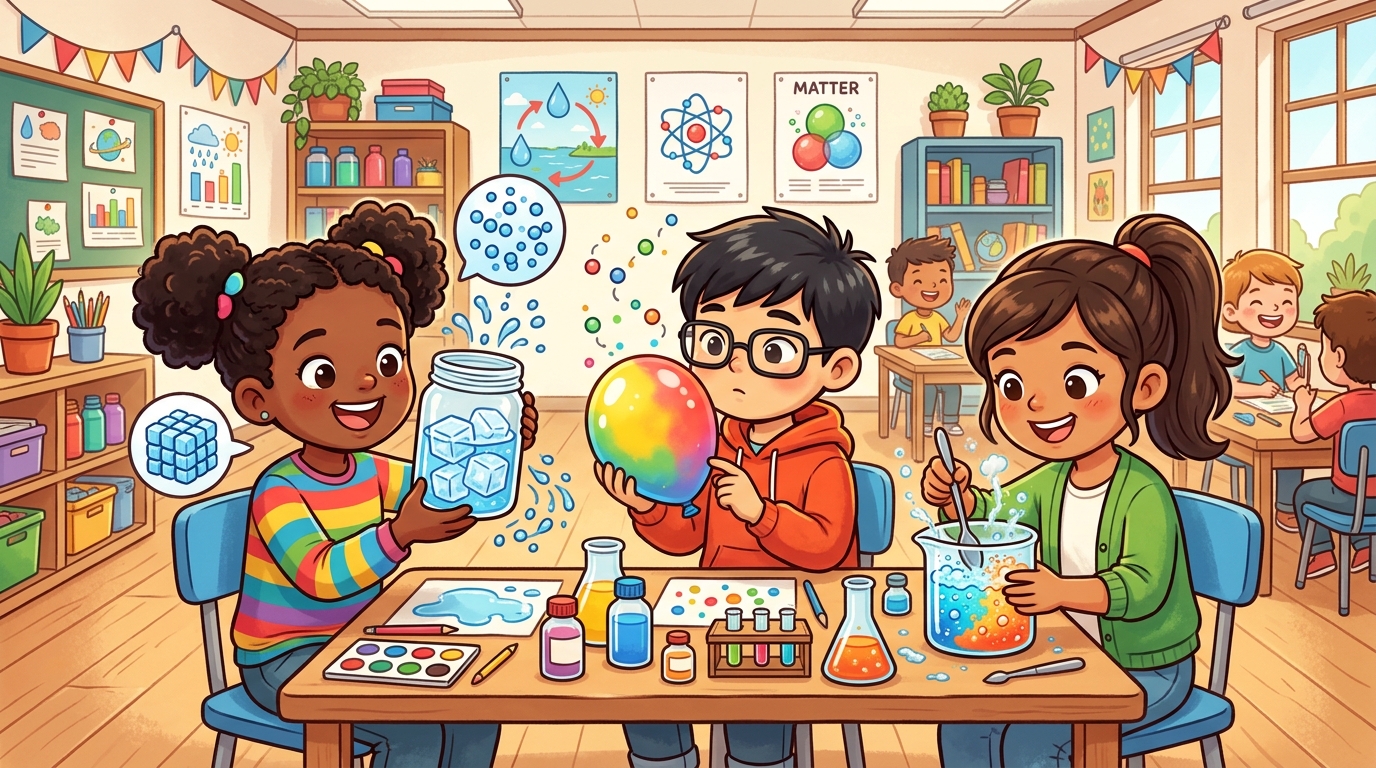
Everything around you — your desk, the air you breathe, the water in your cup, even the person sitting next to you — is made of matter. Understanding what matter is, how it behaves, and how it changes is one of the most powerful concepts kids can learn in elementary science. It's the foundation for everything from chemistry to cooking to why ice floats.
In this article, you'll find free interactive activities, hands-on experiments, and a printable worksheet to help your students explore properties of matter. Plus, we'll show you inside our complete 7-day digital lesson that covers states of matter, physical properties, physical vs. chemical changes, mixtures, and solutions — with slides, drag-and-drop activities, vocabulary flashcards, a live particle simulator, and more.
Whether you're teaching 4th or 5th graders, this resource has everything you need for an engaging properties of matter unit.
What Is Matter, Anyway?
Before diving into the activities, here's the core idea every student needs to understand:
Matter is anything that has mass and takes up space. Your textbook, a glass of juice, and the air inside a balloon are all matter. Light, sound, and heat are NOT matter — they're forms of energy (a great discussion hook for your class).
Every bit of matter is made of tiny building blocks called atoms. You can't see them, but they're everywhere — there are more atoms in a single glass of water than there are glasses of water in all the oceans on Earth!
The Three States of Matter
Matter comes in three main states:
- Solids have a fixed shape and fixed volume. The particles are packed tightly together and only vibrate in place. Think of an ice cube, a rock, or a pencil.
- Liquids take the shape of their container but keep the same volume. The particles slide past each other freely. Water, milk, and oil are liquids.
- Gases spread out to fill any container. The particles zoom around at high speed and are far apart. Air, steam, and helium are gases.
There's actually a fourth state called plasma — lightning, stars, and neon signs are all made of plasma!
Changing States
When you add or remove heat, matter can change from one state to another:
- Melting: solid → liquid (an ice cube turning into water)
- Freezing: liquid → solid (water turning into ice in the freezer)
- Evaporation: liquid → gas (puddles disappearing on a sunny day)
- Condensation: gas → liquid (morning dew on grass)
Fun fact: water is the only substance on Earth that naturally exists in all three states — solid ice, liquid water, and water vapor gas.
Physical Properties
A physical property is anything you can observe or measure without changing what the substance is. Color, shape, texture, hardness, flexibility, and magnetism are all physical properties. Gold is so malleable that a single ounce can be hammered into a sheet so thin it covers 100 square feet!
Physical vs. Chemical Changes
This is one of the trickiest concepts for kids — and one of the most important.
- A physical change changes shape, size, or state, but the substance stays the same. Melting ice is still water. Cutting paper is still paper. Physical changes are usually reversible.
- A chemical change creates a completely new substance. Burning wood makes ash, smoke, and carbon dioxide — totally different materials. Rusting iron becomes iron oxide. You can't unbake a cake. Chemical changes are usually irreversible.
Mixtures and Solutions
When two or more substances are combined but NOT chemically joined, you have a mixture. You can always separate mixtures using physical methods — filtering, magnetism, evaporation, or just picking pieces out.
A solution is a special mixture where one substance (the solute) dissolves completely into another (the solvent). Salt water is a solution — the salt disappears but you can taste it's there. The ocean is a giant salt solution with about 3.5% dissolved salt.
Free Interactive Activity: Matter or Not?
Want your students to explore these concepts right now? Our free Day 1 preview includes a drag-and-drop activity where students decide whether each item is matter — or just energy pretending to be matter.
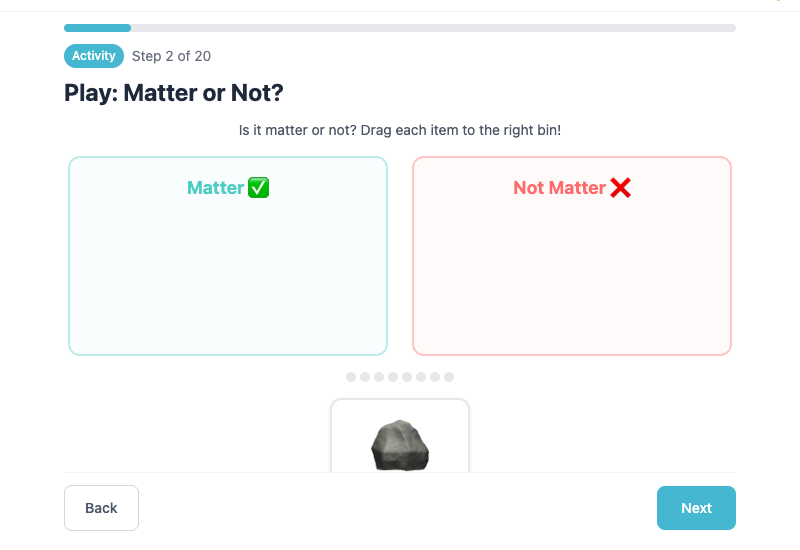
Students drag 8 items (rock, water, air, milk, sand, light, sound, heat) into the correct bin. When they place one correctly, they get a fun fact explaining why it is or isn't matter. This is perfect for surfacing the classic misconception that "if I can see it, it must be matter" — light travels, but it has no mass!
Try the free Day 1 preview — includes the intro slide, the Matter or Not activity, vocabulary flashcards, a fun fact, and discussion prompts.
Free Printable: State Changes Sequencing Worksheet
Print this worksheet for a hands-on companion to the digital activity. Students put the states of matter and the processes that connect them in the right order — a perfect assessment of whether they understand melting, freezing, evaporation, and condensation.
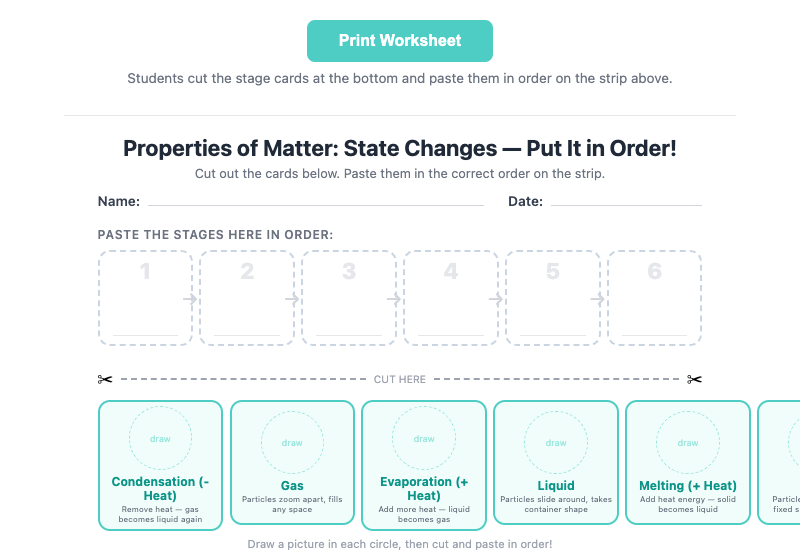
Print the free worksheet — great for independent practice, homework, or a quick formative assessment.
Hands-On Experiments
These experiments bring matter concepts to life with everyday materials you almost certainly already have. We're sharing 2 of the 3 experiments from the full lesson — try them in your classroom!
Experiment 1: Is Air Matter?
What you'll learn: Whether air — something you can't see — really does have mass and take up space.
Materials:
- Two identical balloons
- A ruler or balance
- String
- Tape
Steps:
- Blow up one balloon and leave the other empty.
- Tape both balloons to opposite ends of the ruler.
- Balance the ruler on your finger in the middle, or suspend it from a string.
- Watch carefully — which side tips down?
Think about it:
- Does the inflated balloon weigh more than the empty one?
- What does this prove about whether air is matter?
- Can you think of other ways to show that air takes up space?
Fun fact: Air weighs about 1.2 kilograms per cubic meter — that means the air in your classroom weighs as much as a few students!
Experiment 2: Kitchen Chemistry
What you'll learn: How to tell the difference between a physical and a chemical change — by spotting the clues of a chemical reaction (bubbles, temperature change, new substance).
Materials:
- Baking soda (2 tablespoons)
- Vinegar (1/4 cup)
- A cup or bowl
- Food coloring (optional)
- Paper towels (for spills)
Steps:
- Put 2 tablespoons of baking soda in the cup.
- Add a few drops of food coloring if you want — this makes it extra dramatic.
- Slowly pour the vinegar into the cup.
- Watch what happens! Observe the bubbles, the fizzing sound, and the cup temperature.
- Touch the outside of the cup — is it warmer, cooler, or the same?
Think about it:
- What did you observe when the two substances mixed?
- Is this a physical or chemical change? What evidence tells you?
- What new substance do you think the bubbles are made of? (Hint: it's a gas you breathe out!)
Fun fact: The bubbles are carbon dioxide — the same gas that makes volcanoes in science fairs erupt and bread dough rise. It's a brand-new substance that didn't exist before you mixed the baking soda and vinegar.
Want printable experiment cards and observation journals for all 3 experiments? They're included in the full lesson.
Inside the Full 7-Day Lesson
Our complete Properties of Matter digital lesson gives you everything you need to teach matter, states, changes, mixtures, and solutions over 7 days. Here's what it looks like:
Teacher Dashboard
The teacher dashboard gives you a complete overview of each day — learning objectives, slides, activities, printables, vocabulary, and discussion prompts all in one place.
Scroll down to see printable resources, vocabulary tags, and discussion prompts for each day:
Student Experience
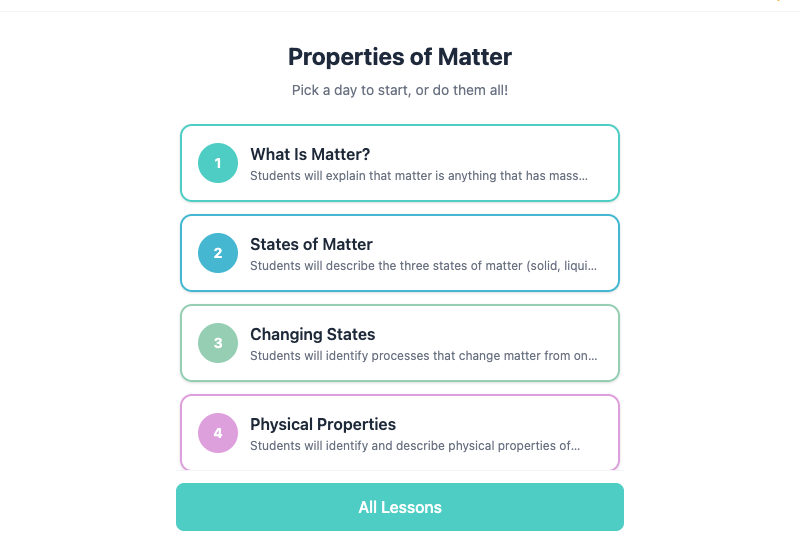
Students pick their day and work through slides, activities, and vocab cards at their own pace:
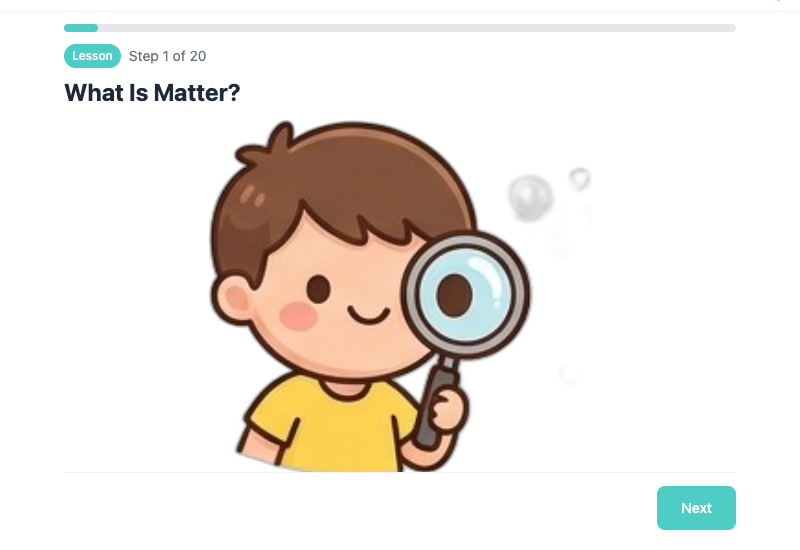
Each day starts with colorful teaching slides that introduce the concept with key facts and fun visuals:
Vocabulary flashcards are built into each day — students tap to flip and learn key terms:
A Live Particle Simulator
One highlight: Day 2 includes a real-time particle simulator. Students drag a temperature slider and watch the particles respond — packed tightly in a solid lattice at cold temperatures, sliding past each other as a liquid, then zooming everywhere as a gas. It's one of those rare classroom moments where an abstract concept becomes instantly concrete.
What's Included
- 7 daily lesson plans with learning objectives and discussion prompts
- 8 teaching slides with colorful diagrams and key facts
- 13 interactive activities (drag-and-drop sorting, matching, ordering, a particle simulator, a kitchen chemist simulation, a solubility bowl, and more)
- 3 hands-on experiments with printable experiment cards
- 28 vocabulary flashcards (4 per day, tap-to-flip)
- 3 printable worksheets (state changes sequencing, physical vs chemical changes compare chart, particle diagrams)
- Observation journals for experiment days
- Fun facts and "Did You Know?" moments throughout
The 7-Day Plan
| Day | Topic | Highlights |
|---|---|---|
| 1 | What Is Matter? | Matter vs. energy intro, Matter or Not sorting activity |
| 2 | States of Matter | Solids, liquids, gases + state sort + live particle simulator |
| 3 | Changing States | Melting, freezing, evaporation, condensation + state change chain |
| 4 | Physical Properties | Color, texture, hardness + property detective + measuring tools match |
| 5 | Physical vs Chemical Changes | Change sort + kitchen chemist simulation |
| 6 | Mixtures | How to separate mixtures + separation station activity |
| 7 | Solutions & Review | Dissolving, solubility bowl + Matter Master quiz |
Get the Full Lesson
Try Day 1 free — no account needed:
Ready for the complete 7-day lesson with all activities, experiments, worksheets, and teacher tools?
Get the full lesson on Teachers Pay Teachers
More Free Science Lessons
Looking for more interactive science content? Check out these free resources:
- Human Body Systems — 6-day guided lesson on all six body systems
- Plant Life Cycle — 5-day guided lesson on seeds, growth, and pollination
- Butterfly Life Cycle — 5-day guided lesson on metamorphosis
- Forms of Energy — 5-day guided lesson on light, sound, heat, and motion
- Solar System — 7-day guided lesson on planets, space objects, and Earth's place in the universe