Solar System for Kids: Free Activities, Experiments & Lesson Plans
Explore the Sun, planets, asteroids, and comets with free interactive activities, hands-on experiments, and printable worksheets. Preview our complete 7-day interactive lesson plan for 3rd-5th grade.
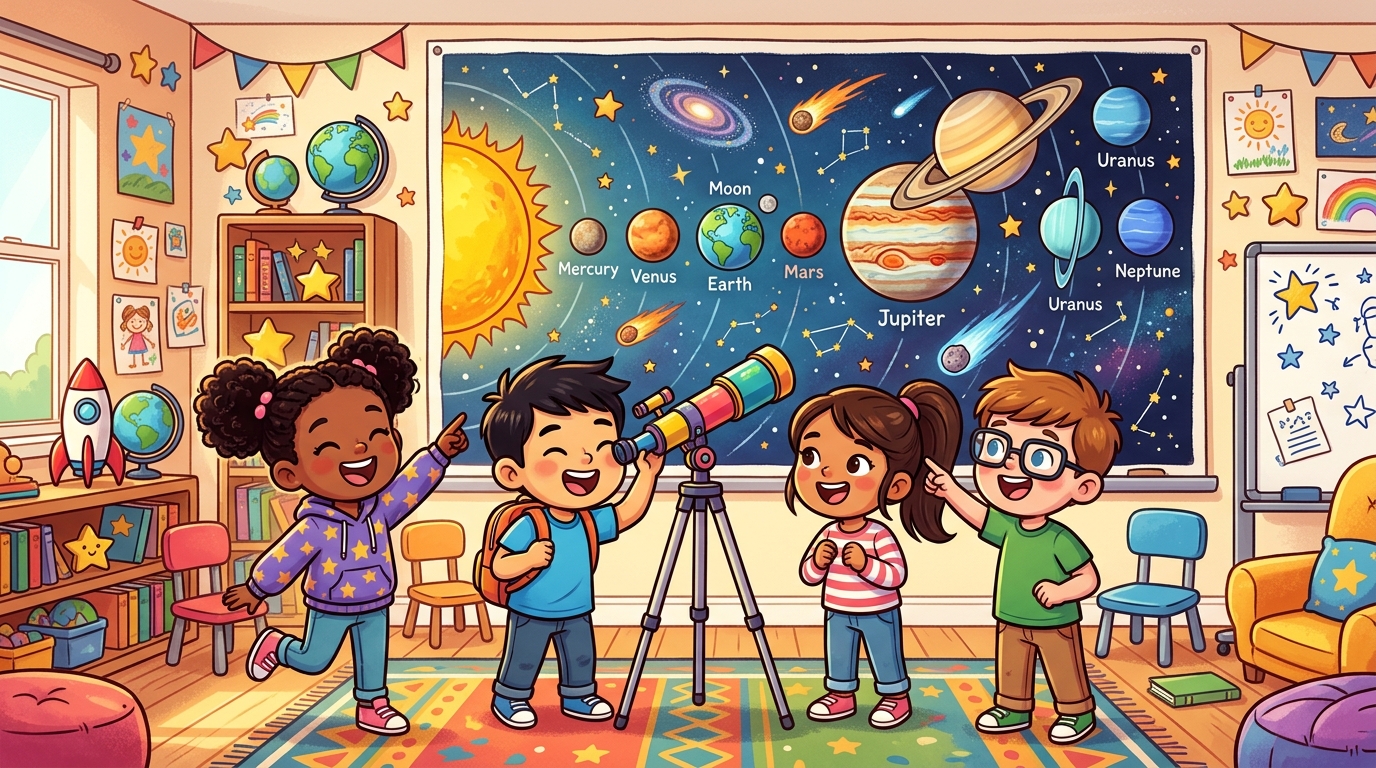
What has 8 planets, a star at the center, asteroids, comets, and one very special blue dot we call home? Our solar system is a mind-blowing neighborhood in space — and your students are going to love exploring every corner of it.
In this article, you'll find free interactive activities, hands-on experiments your students can do with everyday materials, a free printable worksheet, and a preview of our complete 7-day interactive lesson plan designed for 3rd-5th graders.
Whether you're teaching a full space unit or just need a fun Friday activity, we've got you covered.
What Is the Solar System?
Our solar system is the Sun and everything that orbits around it — 8 planets, their moons, asteroids, comets, and dwarf planets. The Sun is a star, a giant ball of hot, glowing gas that makes its own light and heat. It sits at the center, and everything else revolves around it.
The 8 Planets (In Order!)
Here's an easy way to remember the planet order: My Very Excited Mother Just Served Us Nachos!
- Mercury — the smallest planet, covered in craters, and closest to the Sun
- Venus — the hottest planet (even hotter than Mercury!) with thick, crushing clouds
- Earth — the only planet with liquid water and life
- Mars — the red planet, with the tallest volcano in the solar system
- Jupiter — the biggest planet, with a storm bigger than Earth (the Great Red Spot)
- Saturn — famous for its beautiful rings of ice and rock
- Uranus — an ice giant that spins on its side
- Neptune — the farthest planet, with winds faster than any on Earth
The first four (Mercury, Venus, Earth, Mars) are called terrestrial or rocky planets — they have hard, solid surfaces. The outer four (Jupiter, Saturn, Uranus, Neptune) are gas giants — huge planets made mostly of gas.
Beyond the Planets
The solar system is more than just planets! Asteroids are rocky objects that mostly live in the asteroid belt between Mars and Jupiter. Comets are balls of ice and dust that grow glowing tails when they get close to the Sun. And dwarf planets like Pluto orbit the Sun but haven't cleared their path of other space stuff.
Day, Night & Seasons
Earth rotates (spins) on its axis once every 24 hours — that's what gives us day and night. It also revolves (travels) around the Sun once every 365 days — that's one year. Earth's axis is tilted about 23.5 degrees, and that tilt is what gives us seasons!
Free Interactive Activity: Explore the Solar System
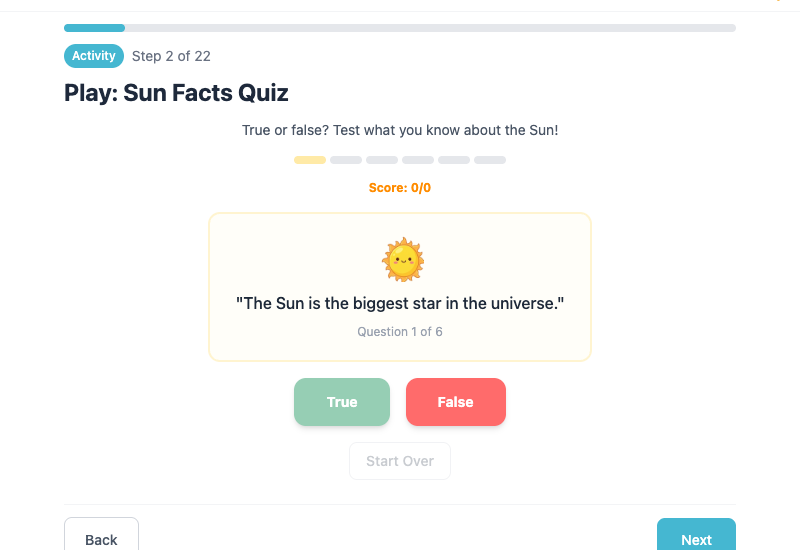
Want to see your students' eyes light up? Let them explore our solar system interactively! In the free Day 1 preview, students learn about the Sun, test their knowledge with a true-or-false Sun Facts Quiz, and drag planets into the correct order from the Sun.
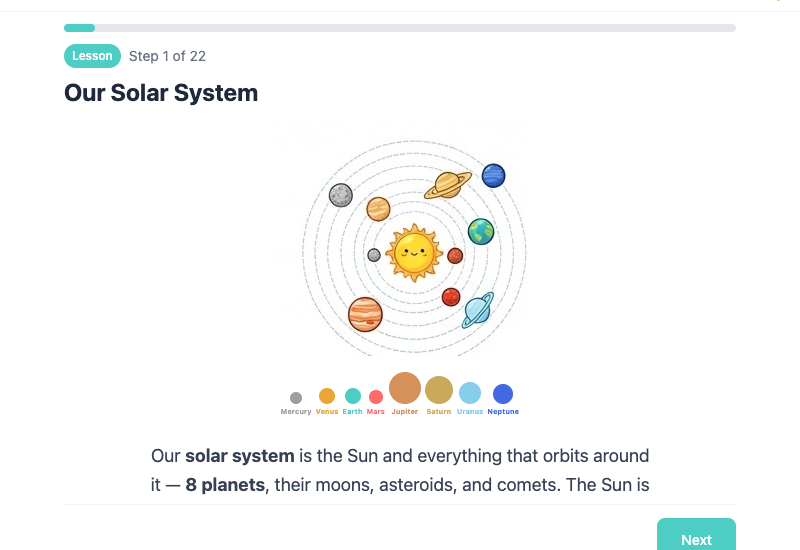
Try it now — no login needed, works on tablets, Chromebooks, and laptops:
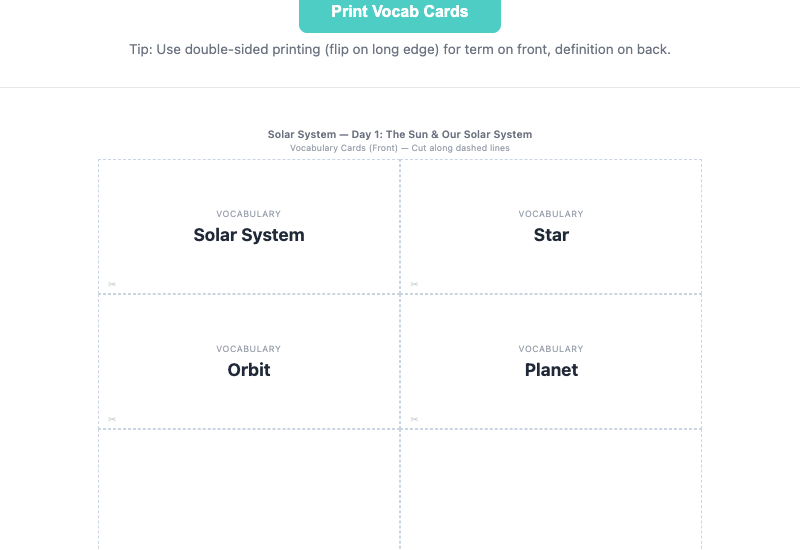
Day 1 also includes vocabulary flashcards (Solar System, Star, Orbit, Planet), a fun fact about the Sun, and discussion prompts.
Free Printable Worksheet: Seasons Sequencing
This cut-and-paste sequencing worksheet has students put the four seasons in the correct order and draw what each season looks like. Great for reinforcing Day 6's lesson on why we have seasons.
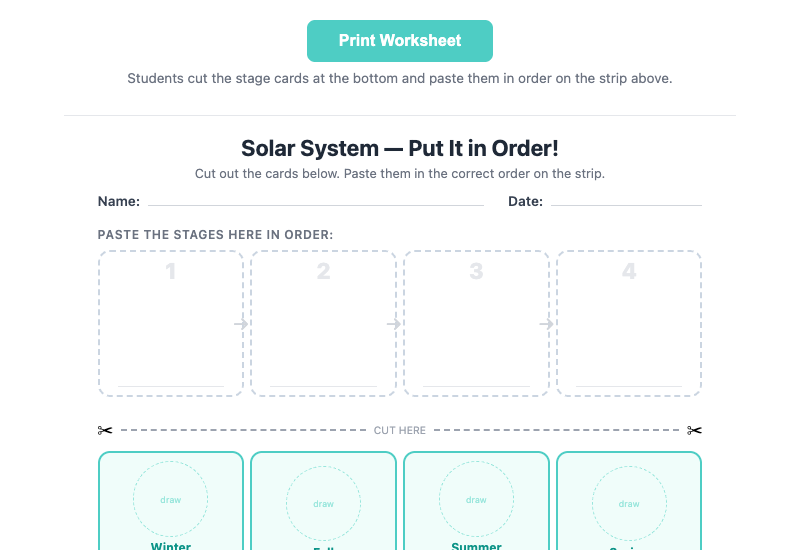
Hands-On Experiments
These experiments use simple, everyday materials and connect directly to the lesson content. We're sharing 4 of our 7 experiments here — the full lesson includes all 7 with printable experiment cards and observation journals.
Experiment 1: Fruit Solar System (Day 1)
Build a scale model of the solar system using fruit! Students see just how much bigger Jupiter is than Mercury — and how far apart everything really is.
Materials:
- A watermelon or large ball (the Sun)
- A peppercorn (Mercury)
- A cherry tomato (Venus)
- A blueberry (Earth)
- A raspberry (Mars)
- An orange (Jupiter)
- A plum (Saturn)
- A grape (Uranus)
- A slightly smaller grape (Neptune)
- A long table or hallway
Steps:
- Place the watermelon at one end of the table — that's your Sun!
- Line up the fruits in order from the Sun: peppercorn, cherry tomato, blueberry, raspberry, orange, plum, grape, grape.
- Space them out — the inner planets should be close together, the outer planets farther apart.
- Walk along your solar system and name each planet as you pass it.
- Try to remember the order: My Very Excited Mother Just Served Us Nachos!
Think about it: Which planet-fruit is biggest? Which is smallest? What would happen if we used the real distances between planets?
Fun fact: If we used real distances with a watermelon Sun, Neptune would be almost half a mile away!
Experiment 2: Crater Impact Lab (Day 2)
Drop marbles into flour to create craters — just like the ones on Mercury and the Moon!
Materials:
- A deep tray or baking pan
- Flour (about 2 inches deep)
- Cocoa powder (sprinkled on top)
- Marbles of different sizes
- A ruler or measuring tape
- A journal for recording results
Steps:
- Fill the tray with flour about 2 inches deep.
- Sprinkle a thin layer of cocoa powder on top — this is your planet's surface!
- Drop a small marble from about 6 inches high. Observe the crater it makes.
- Carefully remove the marble. Measure the crater's width.
- Try dropping bigger marbles and from different heights.
- Compare your craters — which is biggest? Deepest?
Think about it: What happened when you dropped bigger marbles? Did dropping from higher up make a difference?
Fun fact: The biggest crater on Mercury, called Caloris Basin, is about 960 miles wide — big enough to fit the state of Texas inside it!
Experiment 3: Make a Mini Comet (Day 4)
Create your own comet and watch it develop a tail — just like the real thing!
Materials:
- Crushed ice or snow
- Dirt or sand
- A dash of soy sauce (dark color)
- A splash of corn syrup (to hold it together)
- A large zip-lock bag
- A hair dryer or fan
Steps:
- Put 2 cups of crushed ice into the zip-lock bag.
- Add a spoonful of dirt, a dash of soy sauce, and a splash of corn syrup.
- Seal the bag and squish everything together until it forms a ball.
- Take your "comet" out of the bag and place it on a tray.
- Point a hair dryer at it from one side — watch the "tail" form as it melts!
- Notice how the tail always points away from the heat (just like a real comet's tail points away from the Sun).
Think about it: Why does a comet's tail always point away from the Sun? What do you think happens to a comet after many trips around the Sun?
Fun fact: Halley's Comet visits our neighborhood every 75-76 years. It was last seen in 1986 and will return in 2061!
Experiment 4: Flashlight Earth (Day 6)
Use a flashlight and a globe to model day, night, and seasons!
Materials:
- A globe or ball with a line drawn around the middle (equator)
- A flashlight
- A dark room
- A small sticker or dot (to mark "your city")
- A pencil or stick poked through the ball (for the axis)
Steps:
- Turn off the lights and shine the flashlight at the globe — that's your Sun!
- Put a sticker on the globe to mark where you live.
- Slowly spin the globe — watch your city go from light to dark!
- Notice: when your city is facing the flashlight, it's daytime. When it faces away, it's nighttime.
- Now tilt the globe slightly and walk it around the flashlight to model a year and seasons.
Think about it: What causes day and night? How does tilting the globe change how much light hits the top and bottom?
Fun fact: A day on Jupiter is only about 10 hours long — it's the fastest-spinning planet in our solar system!
Want printable experiment cards and observation journals for all 7 experiments? They're included in the full lesson plan below.
Inside the Full 7-Day Lesson
Our complete Solar System interactive lesson covers everything from the Sun to the edge of the solar system — in 7 days of engaging, hands-on learning. Here's what it looks like:
Teacher Dashboard
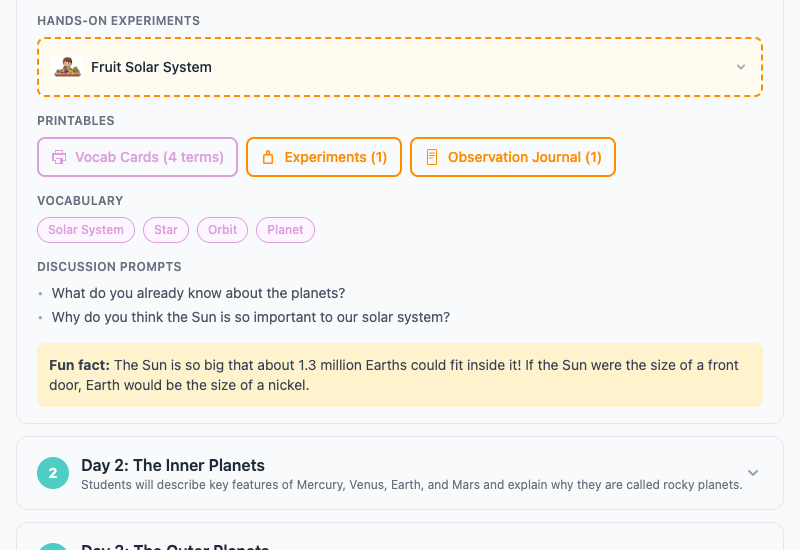
Open the Teacher Dashboard to see all 7 days laid out with slides, activities, experiments, printables, vocabulary, and discussion prompts. Click any slide or activity to project it on your smartboard.
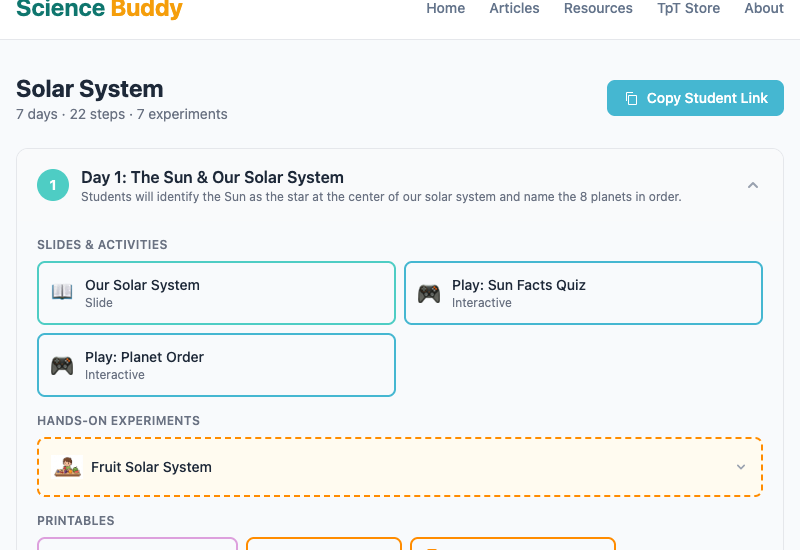
Each day includes printable vocab cards, experiment cards, observation journals, and worksheets — all accessible from the dashboard.
Student View
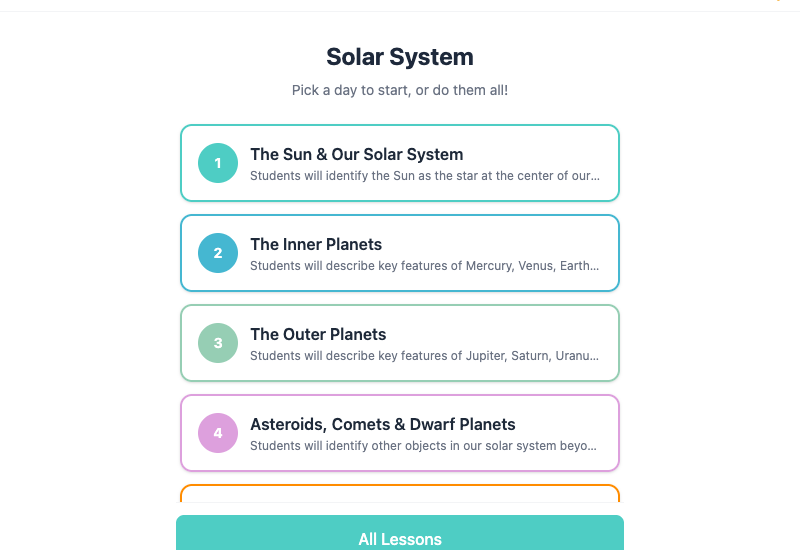
Share the Student Link with your class. Students see a clean day-picker and work through slides, activities, and vocabulary flashcards at their own pace. No login required!
Interactive activities like the Sun Facts Quiz, Planet Order, Planet Sort, and Seasons Explorer keep students engaged and learning.
Vocabulary Flashcards
Each day includes vocabulary flashcards that students can flip through digitally or print out as cut-and-fold cards.
What's Included
- 7 daily lesson plans with learning objectives
- 8 teaching slides (project on your smartboard)
- 14 interactive drag-and-drop activities
- 7 hands-on experiments with printable cards
- 28 vocabulary flashcards
- 3 printable worksheets
- Observation journals for experiment days
- Discussion prompts for each day
- Works on tablets, Chromebooks, and laptops
- No student login required
Get the Full Lesson
Preview Day 1 free — try the slides, activities, and vocab flashcards with your class:
Ready for all 7 days? Get the complete lesson on Teachers Pay Teachers:
More Science Resources
Looking for more interactive lessons? Check out these:
- Butterfly Life Cycle — FREE 5-day interactive lesson for grades 2-3
- Plant Life Cycle — 5-day interactive lesson for grades 2-3
- Forms of Energy — 5-day interactive lesson for grades 1-2
- Human Body Systems — 6-day interactive lesson for grades 4-5
- Circuit Builder — FREE interactive circuit building game for grades 3-5