Why Do Bridges Have Arches?
An arch is one of the strongest shapes in engineering. Find out how it transforms crushing downward force into sideways push — and why the Romans used arches everywhere!
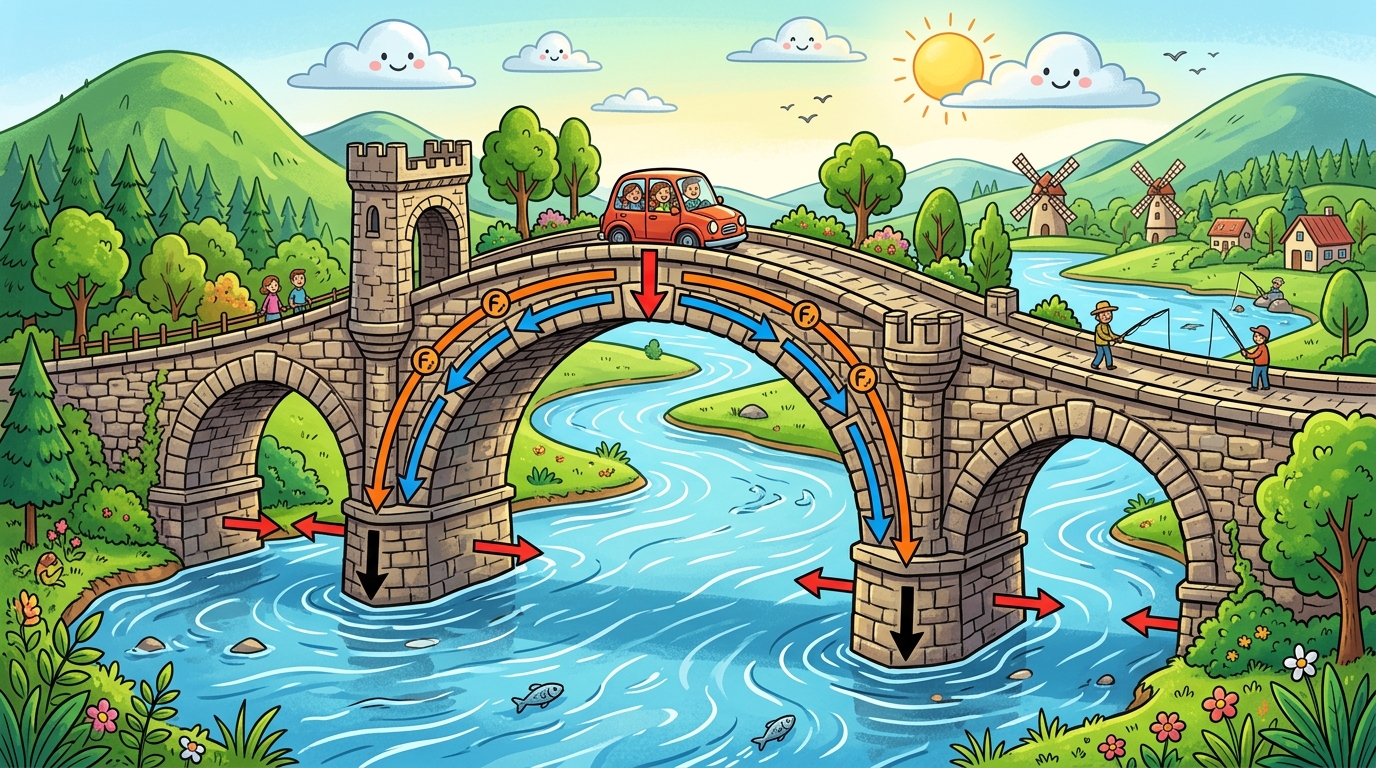
Here's a puzzle: How do you build something out of stone — which is heavy and breaks easily — that can support the weight of cars, trucks, and trains crossing over a river?
The answer is one of humanity's most brilliant inventions: the arch! 🌉
Arches are found in bridges, cathedrals, doorways, and even ancient Roman aqueducts. They're beautiful AND they're one of the strongest shapes in all of engineering.
But why? What makes the curve so special?
The Problem with Flat Bridges
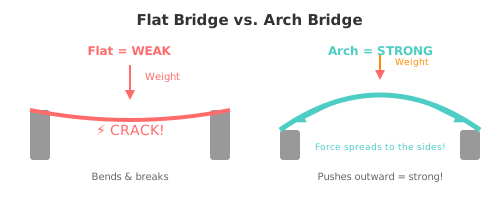
Imagine laying a flat plank of wood across two stacks of books. Now press down on the middle.
What happens? It bends and eventually snaps! 💔
That's because all the weight pushes straight down on the middle, and the flat shape has to resist that force on its own. Engineers call this downward-squishing force compression on the top and stretching force called tension on the bottom.
Stone and concrete are TERRIBLE at handling tension. They crack and break.
The Arch's Superpower: Redirecting Force!
Here's the genius of an arch: it takes the downward force and redirects it sideways and down into the supports.
When something pushes down on the top of an arch:
- The curved shape transfers that force along the curve
- The force travels through each stone to the next
- All the force ends up pushing the supports outward and downward
- The ground pushes back (it's solid rock!) and the whole thing stays up
Every single piece of the arch is being SQUEEZED (compressed), never stretched. And stone is amazing at handling squeezing forces — it's 10 times stronger in compression than in tension!
Fun Fact! The Pont du Gard in France is a Roman arch bridge/aqueduct built around 19 BC. It's still standing after more than 2,000 years! Some modern concrete bridges barely last 50 years.
The Keystone: The Most Important Piece
At the very top of an arch is a special wedge-shaped stone called the keystone. It's the LAST stone placed during construction, and it locks everything together.
Without the keystone, the arch would collapse. With it, each stone pushes against its neighbors and the whole structure becomes incredibly strong.
Here's the mind-blowing part: the heavier the load on top, the MORE the stones push against each other, and the STRONGER the arch gets! It's the opposite of a flat bridge!
The Romans Were Arch Masters
The ancient Romans didn't invent the arch (the Mesopotamians and Etruscans used them earlier), but they perfected it and used arches EVERYWHERE:
- Bridges to cross rivers
- Aqueducts to carry water across valleys (some stretching 30+ miles!)
- The Colosseum — built with 80 arched entrances
- Triumphal arches to celebrate military victories
The Roman Empire couldn't have existed without arch technology. It allowed them to build roads, bridges, and water systems across their vast territory.
Fun Fact! The Colosseum in Rome has 240 arches and could hold 50,000 spectators. Its design is so clever that the entire crowd could enter or exit in just 15 minutes!
Modern Arch Bridges
Today's engineers still use arches, but with modern materials:
- The Sydney Harbour Bridge (Australia) — A steel arch bridge with a span of 1,650 feet
- The Chaotianmen Bridge (China) — The world's longest arch bridge at 1,811 feet
- The Pont d'Arc (France) — A natural limestone arch carved by a river over millions of years!
Modern bridges also use other clever shapes:
- Suspension bridges (like the Golden Gate) — cables hold up the road
- Cable-stayed bridges — cables go directly from towers to the road
- Truss bridges — triangles create a strong framework
But the arch remains one of the strongest, most elegant solutions in engineering!
Nature's Arches
Arches aren't just human-made! Nature creates them too:
- Arches National Park in Utah has over 2,000 natural stone arches
- Sea arches form when waves erode coastal rock
- Your own feet have arches that help distribute your body weight when you walk!
Try It Yourself! 🧪
Build a Paper Arch Bridge
What you need:
- Several sheets of paper
- Books (for supports and weights)
- Tape
- Small toy cars or coins for testing
Steps:
- First, lay a flat piece of paper between two stacks of books (about 6 inches apart)
- Place coins on top one at a time. See how many it holds before it collapses
- Now curve another piece of paper into an arch shape between the books
- Tape the ends so they don't slide
- Place coins on top of the arch. How many can it hold now?
The arch should hold MANY more coins than the flat bridge!
Extra challenge: Try building an arch from small wooden blocks without any glue. Can you get it to stand with just a keystone holding everything together?
Quick Quiz! ✅
Test what you learned:
- What does an arch do to the downward force placed on it?
- What is the keystone and why is it important?
- Why is stone better in an arch than in a flat bridge?
(Answers: 1. It redirects it sideways and down into the supports 2. The wedge-shaped stone at the top that locks all the other stones together 3. Stone is strong in compression (squeezing) but weak in tension (stretching) — arches keep everything in compression)
Keep exploring, Science Buddy! There's always more to discover. 🔬