Why Do Leaves Change Color in Fall?
Ever wonder why trees turn red, orange, and yellow in autumn? The answer involves hidden pigments and a tree's clever survival trick!
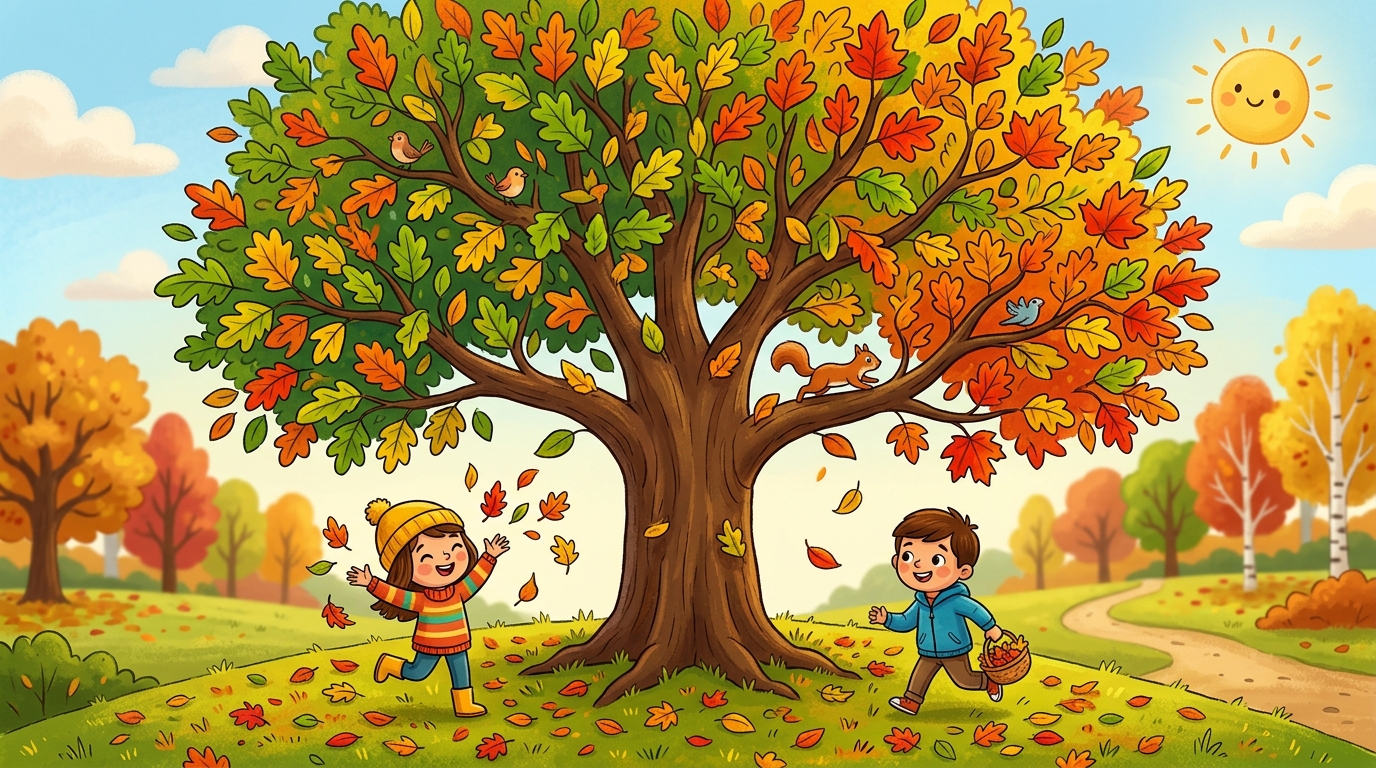
Have you ever looked at a tree in fall and thought, "Wow, where did all those colors come from?" 🍂
One day the leaves are green, and the next — BOOM — they're red, orange, yellow, and even purple! But here's the really cool part: those colors were hiding inside the leaves the whole time.
Let's find out how!
The Green Machine: Chlorophyll
During spring and summer, leaves are busy little factories. They're filled with a green chemical called chlorophyll (say it: KLOR-oh-fill).
Chlorophyll has one SUPER important job: it captures sunlight and turns it into food for the tree. This process is called photosynthesis — which is just a fancy word for "making food from light."
Because there's SO much chlorophyll in every leaf, it covers up all the other colors. That's why leaves look green most of the year!
Fun Fact! A single large tree can have 200,000 leaves, and together they make enough food to keep the whole tree alive!
The Hidden Colors Come Out
Here's where it gets exciting. When fall arrives, days get shorter and temperatures drop. The tree senses this and thinks, "Winter is coming. Time to save energy!"
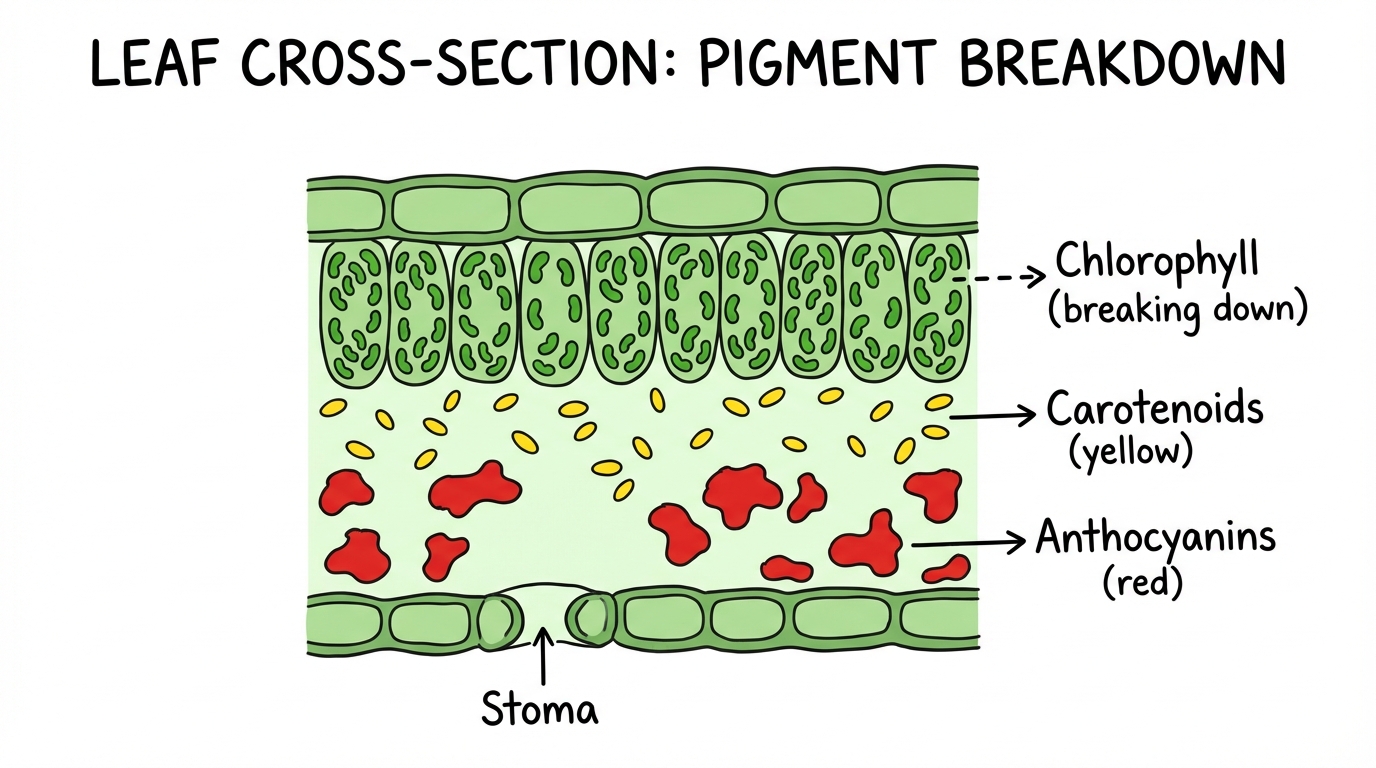
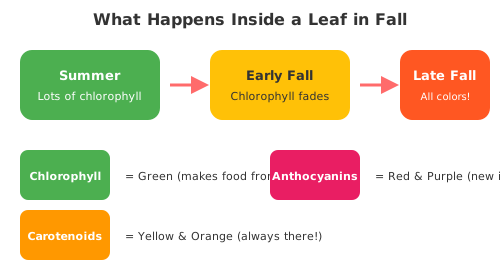
The tree slowly stops making chlorophyll. As the green fades away, guess what's underneath?
Secret pigments that were there ALL ALONG:
- 🟡 Carotenoids — These make leaves yellow and orange (they're the same chemicals that make carrots orange!)
- 🔴 Anthocyanins — These create red and purple colors (the tree actually makes these NEW in fall as a kind of sunscreen!)
Why Do Trees Bother?
Great question! Trees drop their leaves to survive winter. Leaves lose water, and in winter there isn't much water to spare. So the tree seals off each leaf, stops sending it water and nutrients, and lets it fall.
Before the leaf drops, the tree pulls back as many useful nutrients as it can — like a squirrel saving nuts for winter!
Fun Fact! Evergreen trees (like pine trees) don't lose their leaves because their needles have a waxy coating that prevents water loss. Clever, right?
Not All Trees Are the Same
Different trees make different colors:
- Maple trees → Bright reds and oranges 🍁
- Oak trees → Deep reds and browns
- Birch trees → Golden yellows ✨
- Dogwood trees → Purple-red
The exact colors depend on the weather too! Warm sunny days and cool nights make the BRIGHTEST fall colors.
Try It Yourself! 🧪
Leaf Pigment Experiment
Want to see the hidden colors in a green leaf? Here's how!
What you need:
- A few fresh green leaves (spinach works great!)
- Rubbing alcohol (ask a grown-up for help)
- A glass jar
- Coffee filter or white paper towel strip
- A pencil and tape
Steps:
- Tear the leaves into tiny pieces and put them in the jar
- Add just enough rubbing alcohol to cover the leaves
- Mush them up with a spoon (the liquid should turn dark green)
- Tape a strip of coffee filter to a pencil and rest it across the jar so the strip just touches the liquid
- Wait 1-2 hours and watch the colors separate up the paper!
You should see bands of green, yellow, and maybe even orange — those are the hidden pigments!
Quick Quiz! ✅
Test what you learned:
- What chemical makes leaves green?
- What are carotenoids responsible for?
- Why do trees drop their leaves in fall?
(Answers: 1. Chlorophyll 2. Yellow and orange colors 3. To save water and survive winter)
Keep exploring, Science Buddy! There's always more to discover. 🔬