Why Does Ice Float?
Almost every substance sinks when it freezes. But water does the OPPOSITE — and that weird quirk is the reason life on Earth exists!
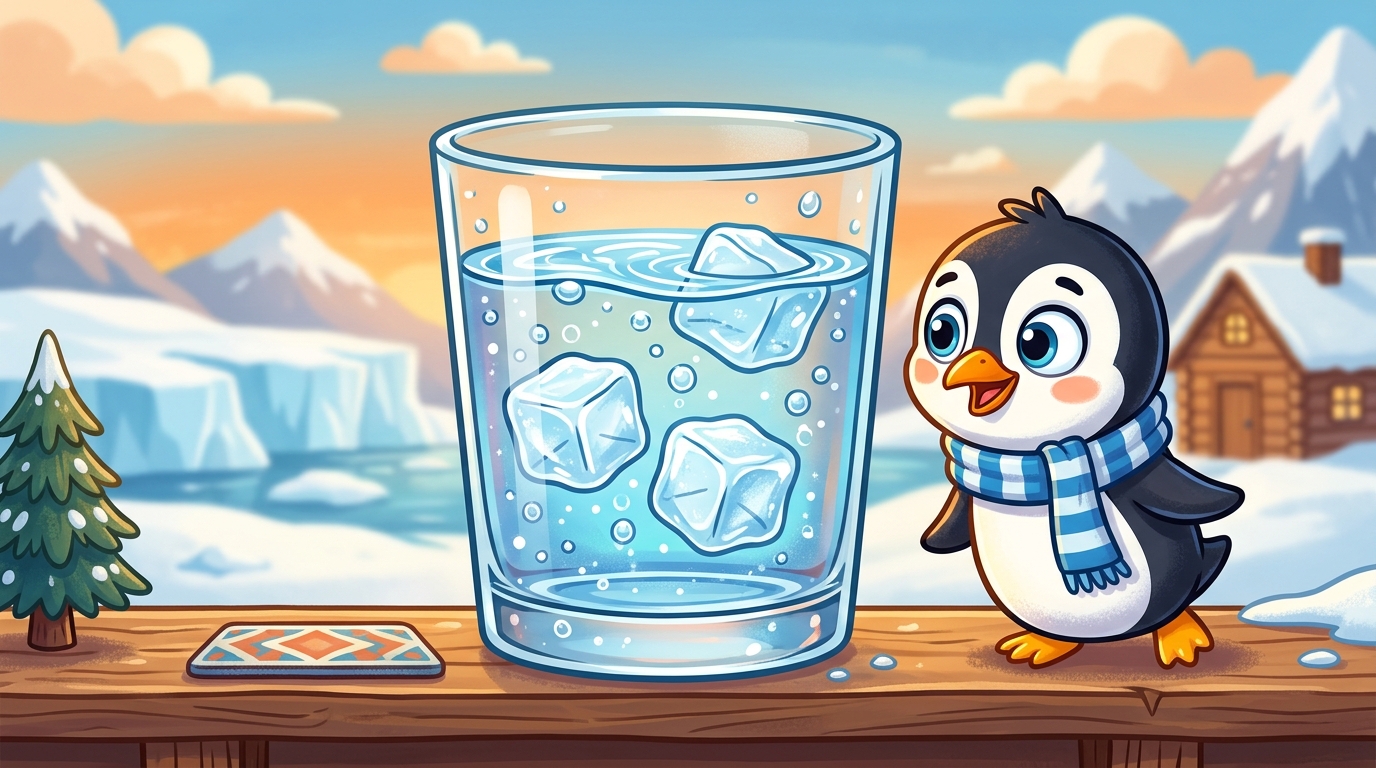
Pop quiz: if you freeze something, does it get heavier or lighter?
Most people guess heavier. And for almost every substance, they'd be right — when things freeze, they get denser and sink.
But water? Water is a total rebel. ❄️
Ice floats. And that one weird fact is actually the reason life exists on Earth. Mind = blown? Let's find out why!
The Weird Thing About Water
Here's the rule that almost everything follows:
- Liquid → molecules move around freely
- Solid → molecules pack tightly together = denser and heavier = sinks
Molten iron sinks through liquid iron. Solid butter sinks in melted butter. This is normal!
But when water freezes into ice, it actually expands and gets LESS dense. It takes up about 9% more space as ice than as liquid water.
That's why:
- Ice cubes float in your drink 🧊
- Icebergs float in the ocean
- Lakes freeze from the top down, not the bottom up
Fun Fact! This is why you should never freeze a sealed glass bottle full of water. The expanding ice can shatter the glass! 💥
The Science: Hydrogen Bonds
Water molecules (H₂O) are made of 2 hydrogen atoms and 1 oxygen atom. They're shaped like a little Mickey Mouse head — the oxygen is the face and the two hydrogens are the ears!
Each water molecule can form connections called hydrogen bonds with its neighbors. In liquid water, these bonds are constantly forming and breaking as molecules tumble around.
But when water freezes, something special happens:
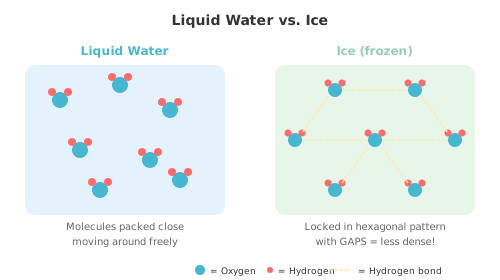
Each molecule locks into a hexagonal (six-sided) crystal pattern. This pattern has gaps and spaces between the molecules — like the holes in a honeycomb.
Those spaces make ice LESS dense than liquid water. And less dense = it floats!
Why This Matters for LIFE! 🌍
If ice sank like normal frozen stuff, here's what would happen:
- Lakes and oceans would freeze from the bottom up
- The ice at the bottom would be insulated from warmth, so it would never melt
- Over time, oceans would freeze almost completely solid
- Fish, whales, coral — all aquatic life would die
But because ice FLOATS:
- It forms a layer on top that acts like a blanket
- The ice insulates the liquid water below, keeping it at about 39°F (4°C)
- Fish and other creatures survive the winter swimming under the ice! 🐟
Fun Fact! Water is densest at exactly 39°F (4°C) — not at freezing (32°F). That's why the bottom of a winter lake stays at 39°F while the surface freezes!
Water's Other Superpowers
Water is weird in LOTS of ways:
- Universal solvent — It dissolves more substances than any other liquid
- High surface tension — Water strider bugs can walk on it!
- High heat capacity — Oceans absorb enormous amounts of heat, keeping Earth's temperature stable
- Capillary action — Water climbs UP inside thin tubes (this is how plants drink!)
All of these special properties come from those hydrogen bonds between water molecules. Water is basically the superhero of molecules! 🦸
Try It Yourself! 🧪
Experiment 1: See Ice Expand
What you need:
- A plastic cup
- Water
- A marker
- A freezer
Steps:
- Fill the cup about 3/4 full with water
- Mark the water level with the marker
- Put it in the freezer overnight
- Check in the morning — the ice should be ABOVE your mark!
- That's the 9% expansion!
Experiment 2: Density Tower
What you need:
- A tall clear glass
- Honey, corn syrup, dish soap, water, vegetable oil
- Food coloring for the water
Steps:
- Pour honey in first (densest — sinks to bottom)
- Then corn syrup
- Then dish soap
- Then colored water
- Then vegetable oil (least dense — floats on top)
- You made a density rainbow! Each liquid floats on the denser one below.
Quick Quiz! ✅
Test what you learned:
- Why does ice float instead of sink?
- What pattern do water molecules form when they freeze?
- Why is floating ice important for life on Earth?
(Answers: 1. Ice is less dense than liquid water because molecules lock into a pattern with gaps 2. A hexagonal crystal pattern 3. It forms an insulating blanket on top of lakes and oceans, keeping the water below liquid so aquatic life survives)
Keep exploring, Science Buddy! There's always more to discover. 🔬